
A procurement team writes a specification, invites three quotations and takes the lowest compliant bid. For pumps and cables that works. For a solar plant it quietly buys the wrong thing — because the three quotations are not really comparable.
Updated October 2026 · Written and reviewed by the Frostec Solar Powers engineering team
- Product thinking buys panels, inverters and cables at the lowest price; system thinking buys a guaranteed lifetime outcome.
- “50 kW of solar” describes nameplate capacity, not energy delivered, safety or lifespan — so price-per-watt comparisons mislead.
- Fragmented scope means nobody owns the result when performance falls short.
- Specify outcomes (yield, protection, documentation, O&M) and compare quotations on lifecycle cost.
What is the difference between product thinking and system thinking?
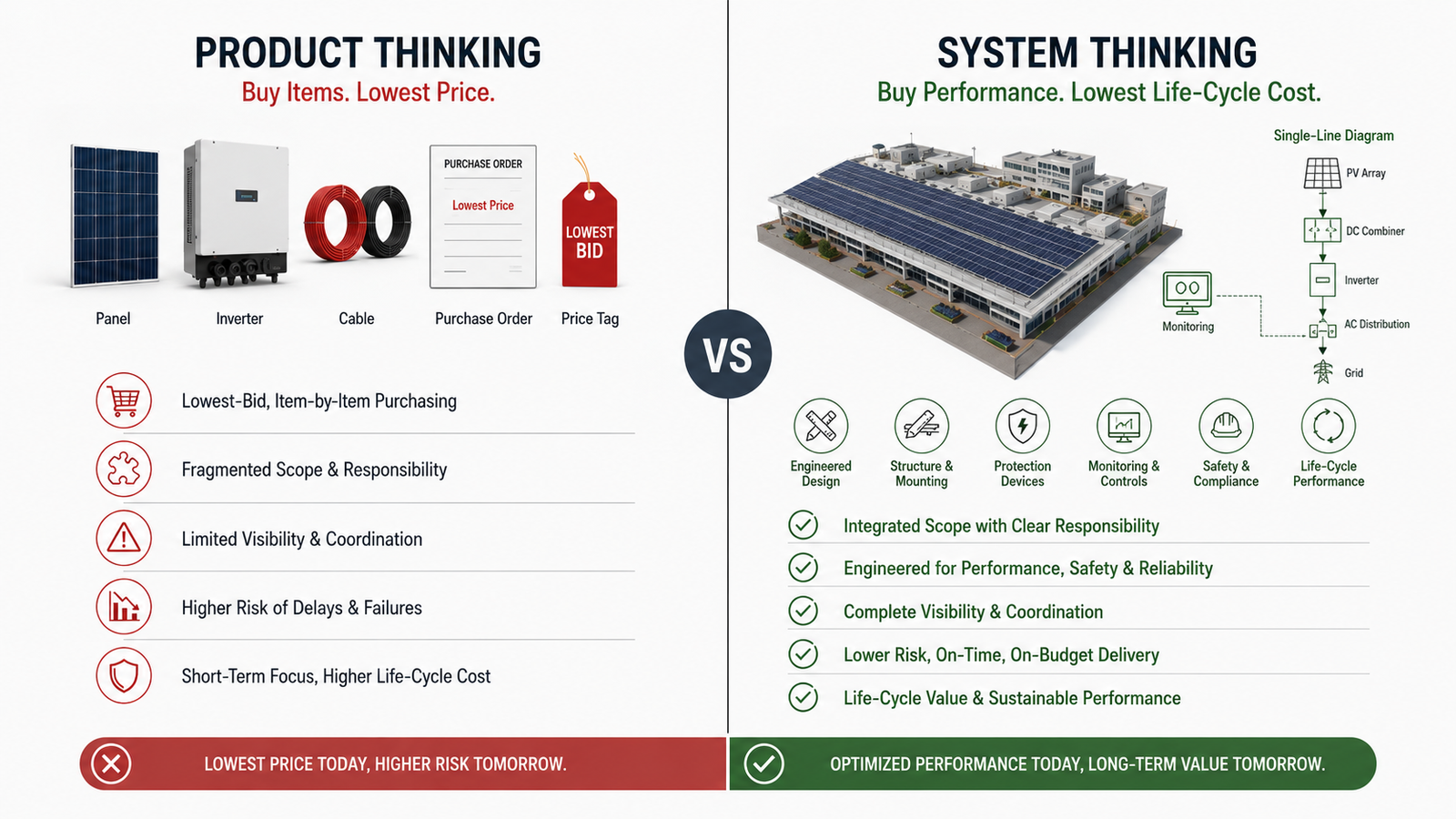
Product thinking treats solar as a list of components to be bought at the lowest price for a given capacity. System thinking treats solar as one engineered asset whose value depends on how those components are designed to work together for 25 years. The first optimises the purchase price; the second optimises energy delivered, reliability, safety and total cost of ownership.
Why the standard purchase order breaks on solar
A normal purchase order works because the item is fully defined: a pump of a given head and flow is the same from any vendor. “50 kW of solar” is not. Two quotations for the same capacity can differ in string design, cable cross-section, structure, protection, inverter derating and documentation — none of which shows up in price per watt.
| Product thinking | System thinking |
|---|---|
| Lowest bid, item-by-item purchasing | Integrated scope with one party responsible |
| Specification lists components | Specification defines outcomes: yield, safety, life |
| Compares price per watt | Compares lifecycle cost per unit of energy |
| Limited visibility and coordination | Design documents, monitoring and commissioning records |
| Short-term focus, higher lifecycle cost | Lower risk, on-time delivery, long-term value |
What product thinking accidentally rewards
- Undersized cables and connectors that save money now and lose energy every day.
- Missing surge protection and weak earthing — invisible until the first lightning season.
- Inverters chosen without temperature derating for Bangladeshi rooftops.
- Split contracts where the panel supplier, electrician and structure fabricator each blame the others.
What system thinking changes in practice
The right-hand side of the infographic lists the system elements — engineered design, structure and mounting, protection devices, monitoring and controls, safety and compliance, and lifecycle performance. In practice, system thinking means:
- Asking bidders for a design package — layout, string plan, single-line diagram and yield estimate — not just a bill of quantities.
- Defining minimum protection: DC/AC isolation, SPDs, fuses, earthing resistance targets.
- Comparing bids on estimated lifetime energy and cost, not only capital cost.
- Requiring commissioning tests, handover documents and an O&M plan.
- Holding one party accountable for performance.
Procurement checklist: buy the system, not the components
- Twelve months of bills and the daytime load profile shared with all bidders.
- Site survey and shading analysis done by each bidder.
- Exact panel and inverter models with datasheets — not just brand names.
- Cable sizes and voltage-drop limits stated in writing.
- Structure design for wind uplift and the roof type.
- Protection and earthing scheme with test values at handover.
- Monitoring access for the owner.
- Warranty terms for each component, plus the installer’s workmanship warranty.
- Net-metering documentation responsibility clearly assigned.
For the engineering behind each line, see Solar Is Engineered Infrastructure and The Hidden Engineering Behind a Rooftop Array.
Frequently Asked Questions
Why is lowest-bid procurement risky for solar?
Because quotations for the same kW can hide large differences in design, cables, protection and structure. The cheapest bid often removes exactly the parts that decide energy yield and lifespan.
How do I make solar quotations comparable?
Give every bidder the same data and ask for the same deliverables: exact models, layout, string design, single-line diagram, yield estimate, protection scheme, commissioning tests and warranty terms. Then compare lifecycle cost per unit of energy.
Who should be responsible for a solar plant’s performance?
One EPC party that designs, supplies, installs, commissions and documents the system, so that performance problems cannot fall between separate contractors.
Need Help Comparing Quotations?
Send us the quotations you have. Our engineers will show you where they differ — even if you do not choose us.
Questions? Call or WhatsApp +880 1805-208117 or email info@frostecsolarpowers.com. Figures in this article are indicative and approximate; final values depend on your site survey, design and the manufacturer terms of the equipment supplied.