
Correct Sizing Starts With Real Load, Real Usage & Real Site
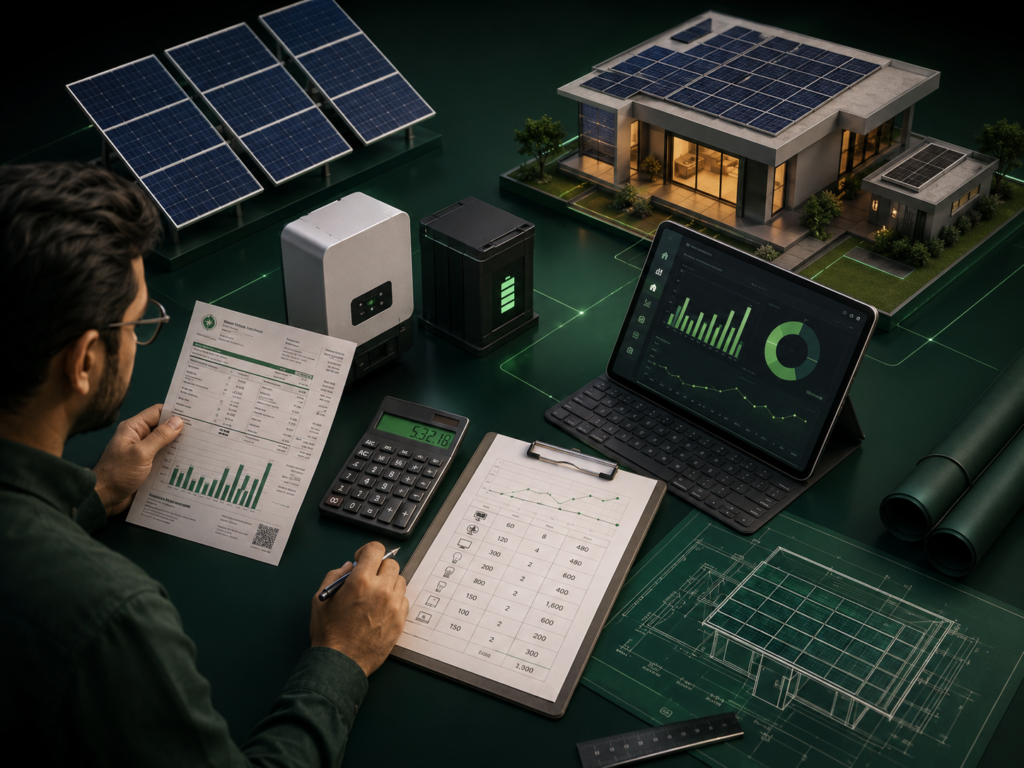
FSP reviews electricity bill, monthly units, load list, backup needs, roof space, inverter capacity, battery requirement, safety margin, and future expansion before recommending solar system size.
Why It Matters
System Size Should Be Calculated, Not Guessed
Oversized = Wasted Money
Paying for capacity you never use is a permanent loss.
Undersized = Disappointment
A system that can’t meet expectation frustrates for years.
Wrong Battery = Poor Backup
Mis-sized batteries cut backup short and die early.
Poor Inverter = Load Issues
An undersized inverter trips on surge loads.
Ignored Surge = Risk
Motors and compressors need surge headroom.
Ignored Roof = Install Problems
Capacity that doesn’t fit the roof is a paper number.
Price-First = Confusion
A size chosen to hit a price isn’t engineering.
The Method
How a System Size Is Built Up
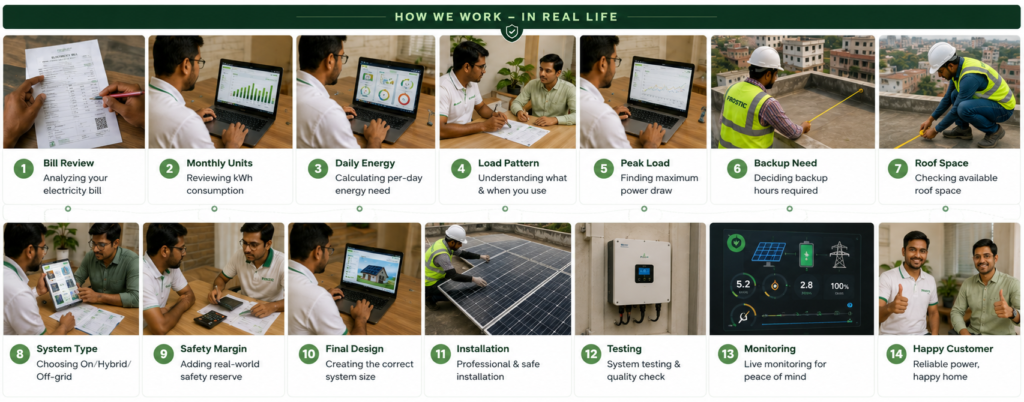
Each input feeds the next. Skip one, and the final number is a guess.
Inputs
What FSP Checks Before Sizing
- Monthly electricity bill
- Monthly unit consumption
- Daily energy use
- Load list
- Essential load
- Peak load
- Surge load
- Backup hour requirement
- System type: on-grid / hybrid / off-grid
- Roof space
- Roof condition
- Shadow
- Inverter location
- Battery location (if required)
- Cable route
- Future load growth
- Safety margin
Residential Sizing
Typical Home Hybrid Sizes
Residential sizing depends on home load, backup requirement, battery capacity, inverter size, surge loads, cloudy weather, roof space, and future growth. The figures below are typical illustrative estimates — your final design may differ.
1 kW Hybrid
Use case: Small flat essentials.
Load: Lights, fans, router, TV.
Roof: ≈ 80 sq. ft.
Battery: ≈ 2.4 kWh
Backup: ≈ 4 hrs (est.)
2 kW Hybrid
Use case: Small family.
Load: Essentials + extra rooms.
Roof: ≈ 150 sq. ft.
Battery: ≈ 5 kWh
Backup: ≈ 5 hrs (est.)
3 kW Hybrid
Use case: Most families.
Load: Essentials + refrigerator.
Roof: ≈ 230 sq. ft.
Battery: ≈ 7 kWh
Backup: ≈ 5 hrs (est.)
5 kW Hybrid
Use case: Larger homes.
Load: Essentials + partial AC.
Roof: ≈ 380 sq. ft.
Battery: ≈ 10 kWh
Backup: ≈ 5 hrs (est.)
6 kW Hybrid
Use case: Big homes / duplex.
Load: Multi-room + AC/motor.
Roof: ≈ 460 sq. ft.
Battery: ≈ 14 kWh
Backup: ≈ 6 hrs (est.)
Commercial Sizing
Sizing a Commercial System
Commercial sizing depends on daytime load, monthly bill, roof utilization, system type, net metering possibility, and operation hours. The example below is illustrative — your real values give your real design.
| Input | Example (illustrative) |
|---|---|
| Monthly bill | ৳60,000 |
| Monthly unit consumption | ≈ 5,500 kWh |
| Daytime load percentage | ≈ 70 % |
| Proposed system size | 30 kW |
| Estimated generation | ≈ 3,600 kWh/mo (estimate) |
| Estimated saving | ≈ ৳39,000/mo (estimate) |
| ROI / payback | ≈ 5 years (estimate) |
Industrial Sizing
Sizing an Industrial Plant
Industrial sizing depends on load profile, monthly units, transformer/MDB/SDB condition, roof area, roof strength, cable route, net metering, and long-term O&M. The example below is illustrative.
| Input | Example (illustrative) |
|---|---|
| Monthly units | ≈ 45,000 kWh |
| Average daily units | ≈ 1,500 kWh |
| Daytime load | ≈ 80 % |
| Proposed capacity | 200 kW |
| Roof area requirement | ≈ 15,000 sq. ft. (≈ 65–80 sq.ft./kW) |
| Inverter location | As per electrical layout |
| Cable route consideration | Routed for minimum voltage drop |
| Net metering feasibility | Subject to utility approval |
| O&M consideration | Covered under AMC scope |
By System Type
On-grid vs Hybrid vs Off-grid Sizing
On-grid
- Sized mainly for bill reduction
- No battery by default
- Best for daytime load
- No backup during grid failure
Hybrid
- Sized for generation + backup
- Includes inverter and battery
- Requires load priority
- Backup hour depends on load & battery
Off-grid
- Sized for independent operation
- Battery is essential
- Requires strict load control
- Needs larger safety margin
Battery & Backup
How Backup Duration Is Sized
Battery sizing depends on selected backup load, running hours, inverter efficiency, usable capacity, charging loss, cloudy-weather margin, and future growth. The example below is illustrative.
| Input | Example (illustrative) |
|---|---|
| Selected backup load | 800 W |
| Backup hours required | 4 hours |
| Inverter size | 3 kVA |
| Battery capacity | 5 kWh |
| Usable capacity | ≈ 4 kWh (after depth-of-discharge) |
| Estimated backup duration | ≈ 4 hours (estimate) |
| Safety margin | 20 % (cloudy-day reserve) |
Roof & Panel Capacity
The Roof Sets the Ceiling
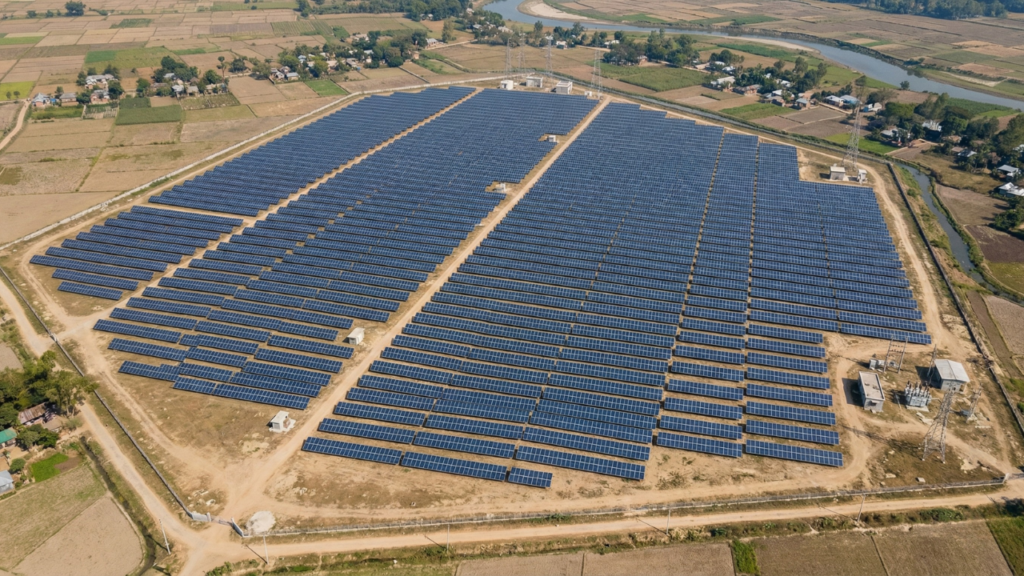
System size is limited by available roof space, shadow, roof type, structure, panel layout, maintenance access, and future expansion. Roughly 65–80 sq. ft. of shadow-free roof per kW.
- Available roof area
- Roof type
- Shadow
- Panel orientation
- Walkway
- Maintenance access
- Future expansion
Safety Margin
Why a Practical Design Adds Margin
A real system loses energy at every stage. Good sizing builds in reserve for all of it.
Inverter Loss
Conversion is never 100% efficient.
Battery Charging Loss
Energy is lost charging and discharging.
Cloudy Weather
Generation drops on overcast days.
Surge Load
Motor startup needs extra headroom.
Future Load Growth
Loads tend to grow over time.
Cable Loss
Voltage drop over distance.
Panel Degradation
≈ 0.5%/year output decline.
Maintenance Factor
Dust and aging reduce yield.
Avoid These
Common Sizing Mistakes
Size From Price Only
Letting budget pick capacity, not load.
Ignoring Load List
Guessing instead of measuring real load.
Ignoring Surge Load
Forgetting motor/compressor startup.
Ignoring Backup Hour
No clarity on required autonomy.
Bill Without Load Pattern
A bill alone hides when energy is used.
Ignoring Roof Space
Promising capacity that won’t fit.
Ignoring Usable Battery
Counting full capacity, not usable.
No Safety Margin
Designing with zero reserve.
No Site Visit
Sizing without seeing the site.
No Future Planning
Ignoring tomorrow’s load growth.
Get Sized
System Sizing Request
Share a few details and our team will review your information and contact you with the next step.
Why FSP
Sizing Done Right
Sizing Before Quotation
The size is engineered before any price.
Load-First Approach
Real load drives the system, not budget.
Roof-First Planning
The roof’s real ceiling is respected.
Backup Requirement Review
Backup hours sized honestly.
Safety Margin Included
Losses and reserves built in.
Engineering Review
Checked by engineers, not salespeople.
Future Expansion
Designed with room to grow.
Clear Recommendation
A size you understand and can verify.
Keep Exploring
Related Pages
Engineering Guides
By Project Type
System Types & Start
FAQ
Sizing Questions
How do I know what size solar system I need?
Can system size be calculated from electricity bill only?
Why is the load list important?
Why does backup hour affect system size?
Does roof space limit solar capacity?
What is the difference between on-grid and hybrid sizing?
Can AC run on residential solar?
Why is safety margin important?
Is a site visit required before final sizing?
Can the system be expanded later?
Ready to Size Your Solar System Correctly?
Before recommending system size or price, FSP reviews your electricity bill, load list, backup requirement, roof condition, inverter capacity, battery requirement, safety margin, and future expansion plan.