
Every rooftop system in Bangladesh needs people to survey, design, install, inspect and maintain it. With a national target of thousands of megawatts, the shortage is no longer panels or money — it is skilled hands.
Updated October 2026 · Written and reviewed by the Frostec Solar Powers engineering team
- Rooftop solar supports more than 25 jobs per MW, compared with about 2 for a large solar park.
- A government skills study projected solar jobs rising from about 1.1 lakh to 2.42 lakh by 2035 — likely an underestimate for today’s targets.
- About 1.55 lakh workers would need short, certified training; about 75,000 need STEM backgrounds.
- The Renewable Energy Policy 2025 directs SREDA to keep a national register of designers, installers, maintenance staff, suppliers and EPC companies.
- On 31 August 2026 the Power Division invited district-based solar service providers to enlist — an opening for local entrepreneurs, young people and women.
Why solar is a jobs story
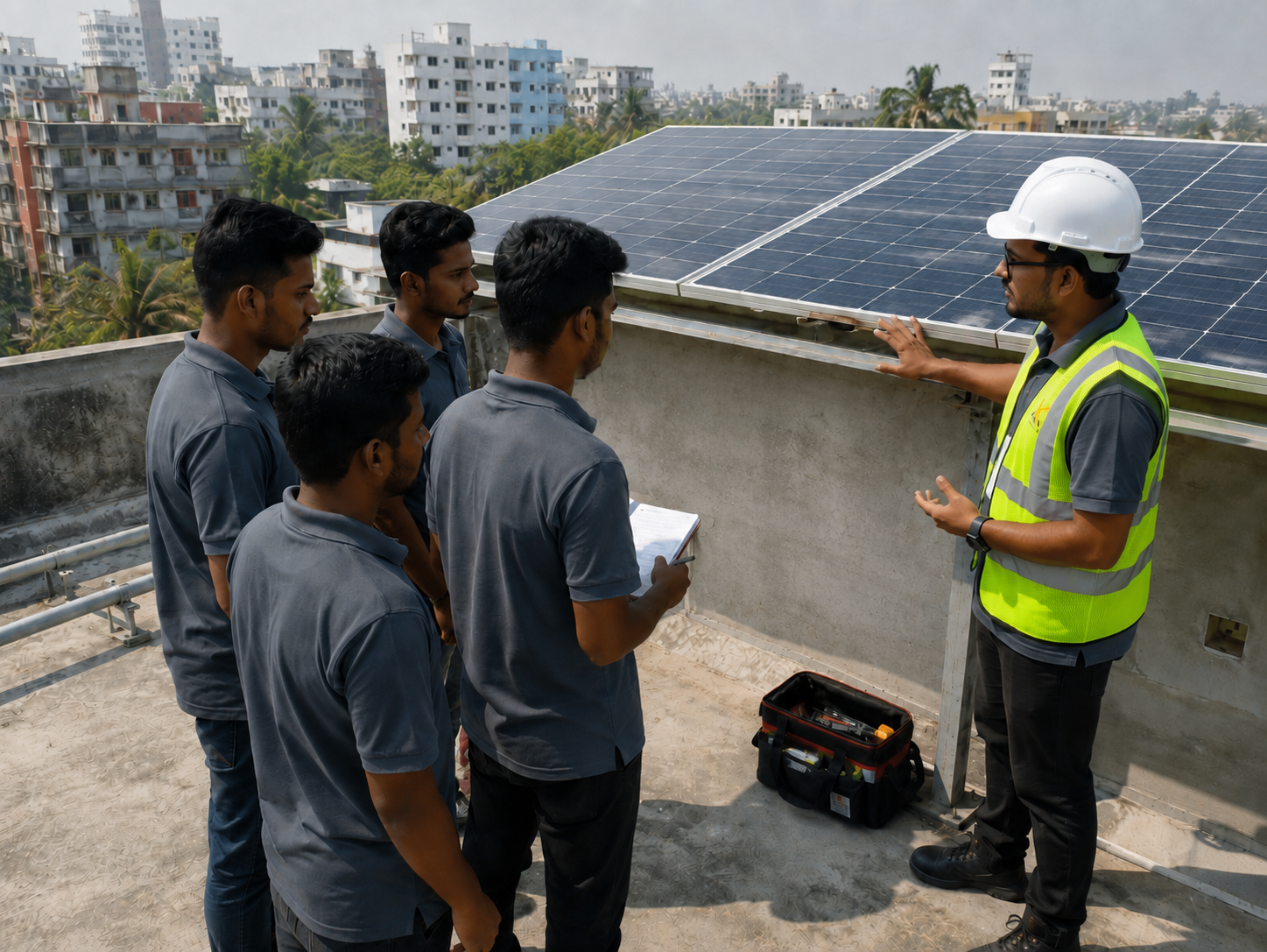
Large solar parks are built once and need few people to run. Rooftop solar is the opposite: thousands of separate sites, each needing a survey, design, installation, paperwork and years of maintenance. Studies estimate around 26.6 jobs per MW for residential rooftop systems, 10.1 for commercial and about 2.1 for utility-scale.
The 2026–2030 strategy plans 5,500 MW of rooftop solar. Even at the lower commercial rate, that is tens of thousands of jobs — see the state of solar in Bangladesh.
The skills gap
- A 2024 study of technical and vocational education found a serious shortage of skilled workers, with about 60% of respondents saying their skills still needed improvement after graduation.
- Training often uses outdated equipment, and links between institutes and employers are weak.
- SREDA, the sector regulator, has a very small staff for its growing role.
- Poor workmanship shows up later as failures — see why low-cost solar fails.
Roles in demand
| Role | Core skills | Typical background |
|---|---|---|
| Solar installer | Mounting, DC wiring, MC4 crimping, working at height safely | Short certified course + site experience |
| Solar electrician | AC/DC protection, earthing, inverter connection, testing | Electrical trade certificate |
| Site surveyor | Roof measurement, shading analysis, load study | Diploma or engineering |
| Design engineer | System sizing, string design, cable sizing, simulation software | EEE or related engineering |
| O&M technician | Cleaning, inspection, fault finding, monitoring data | Short course + experience |
| Battery specialist | BMS, lithium safety, hybrid inverter commissioning | Electrical background + training |
| Project manager | Planning, procurement, net-metering approvals, safety | Engineering or business |
| Sales and finance advisor | Savings calculations, OPEX/CAPEX, loan files | Business with technical training |
New openings in 2026
- District service providers: the Power Division is enlisting providers by district and area to offer installation, packages, customer service and maintenance — with a stated aim of including small entrepreneurs, young people and women, and preventing concentration in big cities.
- National register: under the Renewable Energy Policy 2025, SREDA is to keep a database of designers, installers and maintenance staff, which can support certification and accountability.
- OPEX growth: long-term OPEX contracts under the 2026 ordinance need maintenance teams for 15 years or more — see the ordinance.
How to start a solar career
- Learn electrical safety first: DC arcs, working at height, PPE and isolation procedures.
- Take a practical, certified course with hands-on installation, not theory alone.
- Work under supervision on real sites to build experience.
- Specialise: hybrid and battery systems, commercial design, or O&M.
- Keep learning: rules, incentives and equipment are changing fast — follow our state of solar page.
Frostec offers a 3-month internship in which interns work alongside our engineers on real projects. For formal certified courses, we recommend recognised professional training centres.
Frequently Asked Questions
How many jobs does solar create in Bangladesh?
Rooftop solar creates more than 25 jobs per MW, compared with about 2 for large solar parks. A government skills study projected solar jobs rising from about 1.1 lakh to 2.42 lakh by 2035.
What skills do solar technicians need?
Electrical safety, DC and AC wiring, protection and earthing, mounting and working at height, inverter and battery commissioning, testing and fault finding.
Is there a register of solar installers in Bangladesh?
The Renewable Energy Policy 2025 directs SREDA to maintain a national database of designers, installers, maintenance staff, suppliers, manufacturers and EPC companies.
Can small businesses become solar service providers?
Yes. On 31 August 2026 the Power Division invited applications to enlist district-based solar service providers, aiming to include small entrepreneurs, young people and women.
How do I become a solar technician in Bangladesh?
Start with electrical safety, take a practical certified solar course, gain supervised site experience, then specialise in areas such as hybrid systems, design or maintenance.
Start Your Solar Career
Ask about Frostec’s 3-month internship, where interns work alongside our engineers on real projects.
Questions? Call or WhatsApp +880 1805-208117 or email info@frostecsolarpowers.com. Head office: Suite 708/B, Level 7, Zaman Tower, 37/2 Purana Paltan, Dhaka 1000. Figures in this article are indicative and approximate; final values depend on your site survey, design and the manufacturer terms of the equipment supplied.