
Panels last 25–30 years with little attention. The inverter works harder: it converts every unit of solar energy, manages the battery, talks to the grid and protects the system. Choosing it well decides how much energy you get and how often you need service.
Updated October 2026 · Written and reviewed by the Frostec Solar Powers engineering team
- Choose the type first: on-grid for bill savings, hybrid for savings plus backup, off-grid where there is no reliable grid.
- Panel capacity is usually 10–30% higher than inverter AC rating (DC/AC ratio about 1.1–1.3).
- Check MPPT count and voltage range against your roof layout and string design.
- In Bangladesh, heat tolerance, surge protection, IP65 rating and a wide grid-voltage range matter.
- Local service and warranty terms matter as much as the brand name.
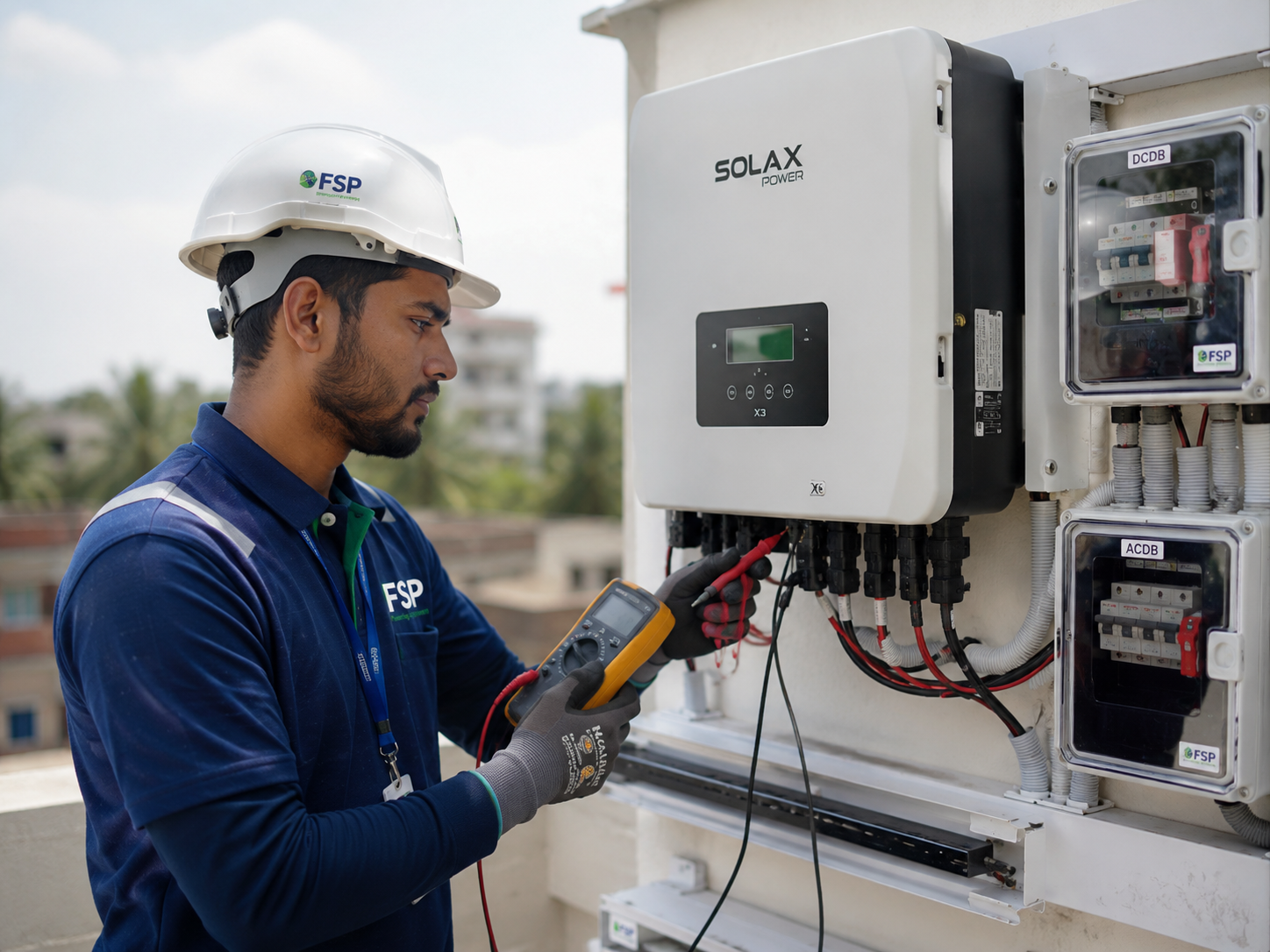
Step 1: choose the inverter type
| Type | What it does | Best for |
|---|---|---|
| On-grid (string) | Converts solar to AC and exports surplus; switches off during outages | Offices, factories, homes focused on bill savings |
| Hybrid | Manages panels, battery and grid together; backup during load shedding | Homes, clinics, shops needing backup |
| Off-grid | Runs loads from panels and battery with no grid | Remote sites, char areas, farms |
| Single-phase / three-phase | Must match your electricity connection | Single-phase for most homes; three-phase for larger buildings |
Not sure which you need? See on-grid vs off-grid vs hybrid.
Step 2: size it correctly
- DC/AC ratio: panels rarely produce their full rating in real conditions, so arrays are usually 10–30% larger than the inverter’s AC rating. Too high a ratio wastes energy at midday; too low wastes inverter capacity.
- Hybrid backup rating: the inverter’s backup output must cover the essential loads you want during outages, including motor starting currents.
- Future expansion: if you plan to add panels or a battery later, choose an inverter with spare MPPT capacity and battery compatibility.
Step 3: check the technical features
| Feature | Why it matters in Bangladesh |
|---|---|
| Number of MPPTs and voltage window | Roofs with different orientations or shading need separate MPPTs; strings must stay in range on hot and cool days |
| Wide AC voltage and frequency range | Keeps the inverter online when grid voltage fluctuates |
| Operating temperature and derating | Rooftop rooms get very hot; check output at 40–45 °C |
| IP65 or better enclosure | Dust and monsoon humidity |
| Built-in DC and AC surge protection | Lightning season — see lightning protection and earthing |
| Battery communication (CAN/RS485) | Hybrid inverters must talk to the lithium battery’s BMS |
| Wi-Fi or 4G monitoring app | Lets you and your installer see faults and generation |
| Compliance for net metering | Equipment must meet BSTI and SREDA standards for utility approval |
Step 4: brand, warranty and local support
Frostec works with inverters from GoodWe, SolaX, Solis, Growatt, Deye and Huawei. All are established manufacturers; the right one depends on your system type, size, battery and budget. Before choosing any brand, check:
- Warranty length and terms: commonly 5–10 years depending on brand and model — always subject to the manufacturer’s terms.
- Who honours it locally: an authorised distributor with spare stock and trained technicians.
- Serial registration: grey imports may have no local warranty support — see how to spot fake equipment.
- Battery compatibility list for hybrid systems.
Installation matters as much as the inverter
- Mount in a shaded, ventilated place with clearance for airflow.
- Correct DC and AC cable sizes, isolators, breakers and earthing.
- Commissioning with recorded string voltages and currents.
Learn more in the hidden engineering behind a rooftop array.
Frequently Asked Questions
What size inverter do I need for my solar panels?
Typically the panel capacity is 10–30% higher than the inverter’s AC rating, a DC/AC ratio of about 1.1–1.3. A hybrid inverter must also cover the essential loads you want during outages.
Which is better, an on-grid or a hybrid inverter?
An on-grid inverter gives the lowest cost and highest savings but no backup. A hybrid inverter adds battery backup for load shedding and can still use net metering.
What is an MPPT?
Maximum power point tracking — a circuit that keeps panels working at their best voltage. Multiple MPPTs let strings facing different directions or with different shading work independently.
Which inverter brands are available in Bangladesh?
Frostec works with GoodWe, SolaX, Solis, Growatt, Deye and Huawei. The best choice depends on system type, size, battery and budget, plus local warranty support.
How long do solar inverter warranties last?
Commonly 5–10 years depending on brand and model, subject to the manufacturer’s terms and registration.
Not Sure Which Inverter Fits?
We match the inverter to your roof, load, battery plan and budget — and explain why.
Questions? Call or WhatsApp +880 1805-208117 or email info@frostecsolarpowers.com. Head office: Suite 708/B, Level 7, Zaman Tower, 37/2 Purana Paltan, Dhaka 1000. Figures in this article are indicative and approximate; final values depend on your site survey, design and the manufacturer terms of the equipment supplied.