

The Purchase Order That Quietly Buys the Wrong Thing
A procurement team runs solar the way it runs every other purchase: write a specification, invite three quotations, take the lowest compliant bid. That process is disciplined and fair. For pumps, cables, and standard equipment, it works.
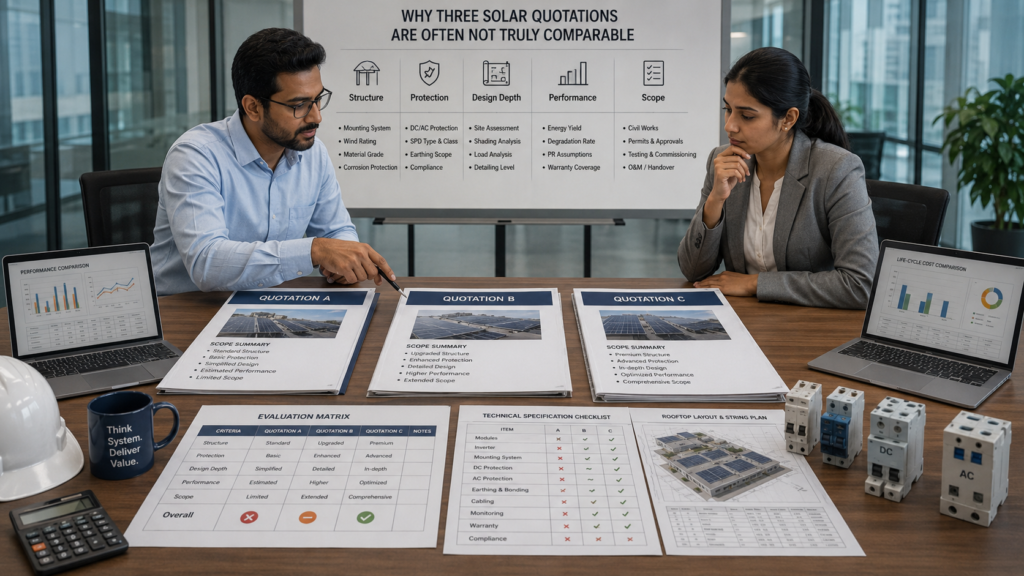
For a solar plant, it quietly buys the wrong thing. The reason is simple — the three quotations are not comparable, and the process assumes they are.
This is the gap between product thinking and system thinking. Closing it is the single most valuable change a buyer can make before signing.
Definition: Product Thinking vs System Thinking
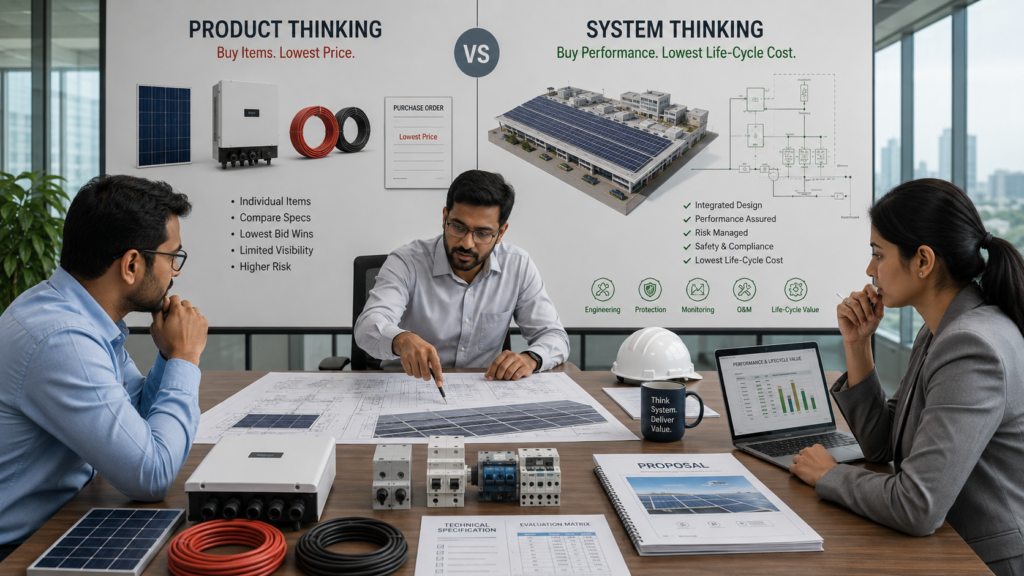
Product thinking treats solar as a set of components to be purchased at the lowest price for a given capacity. System thinking treats solar as one engineered asset whose value is decided by how the components are designed to work together over 25 years.
Product thinking optimizes the purchase price. System thinking optimizes the lifetime outcome: energy delivered, reliability, safety, and the cost of owning the asset. The two approaches can recommend completely different suppliers from the same set of quotations.
Why the Standard Procurement Process Breaks on Solar
A normal purchase order works because the item is defined. A 50 mm pump of a given head and flow is the same item from any vendor. Solar is not like that. “50 kW of solar” describes the nameplate capacity, not the system — and capacity is the one thing that barely affects long-term performance.
Two 50 kW quotations can differ in string design, inverter matching, cable sizing, protection, structural design, commissioning, documentation, and maintenance. Every one of those affects how much energy you actually get and how long the plant lasts. None of them appears on the line that says “50 kW — price.” So the lowest bid usually wins by removing the very things that make the asset perform.
What product thinking accidentally rewards
- The supplier who left protection (DCDB, ACDB, SPD, earthing) vague, because it lowered the price.
- The supplier who skipped the structural review, because it saved engineering time.
- The supplier who undersized cables, because thinner copper is cheaper.
- The supplier who quoted no commissioning and no documentation, because both cost effort.
In a price-led comparison, the most cut-down quotation looks like the best deal. That is the trap.
What System Thinking Changes in Practice
System thinking does not mean spending more for its own sake. It means changing what you compare. Instead of comparing totals, you compare what each supplier is actually engineering and documenting.
The practical shift is to require every bidder to submit the design, not just the price. When all three must show string layout, inverter sizing logic, protection specification, structural approach, and commissioning plan, the differences become visible — and the comparison becomes fair for the first time. Often the cheapest bid reveals itself as the least engineered, and the decision changes.
The Business Implication
A procurement decision made on price alone transfers risk forward in time. The savings are booked today; the cost arrives as lost generation, early failures, downtime, and an asset nobody can diagnose. Because those costs land in operations, not procurement, the process rarely learns from them.
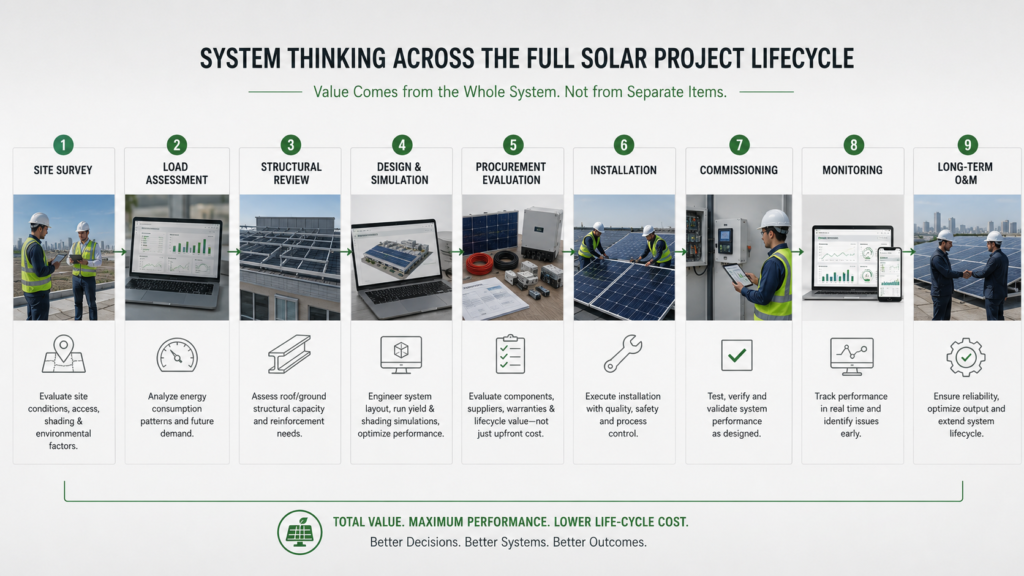
System thinking keeps the decision honest by valuing the whole life of the asset. Any payback or savings figure used in that evaluation should be treated as approximate and tied to your tariff, load profile, roof, and equipment quality — not accepted as a guarantee.
Common Procurement Mistakes
- Comparing quotations on total price and price per watt, with no design attached.
- Writing a tender spec by capacity only (“supply 50 kW”), which invites cut-down bids.
- Not requiring structural review, protection specification, or a commissioning plan in the tender.
- Treating documentation and monitoring as optional extras rather than deliverables.
- Letting the lowest compliant bid win automatically, with no technical scoring.
- Ignoring the supplier’s ability to support, service, and warranty the plant for years.
Procurement Checklist: Buy the System, Not the Components
- Does the tender require a design submission (string layout, single-line diagram), not just a price?
- Are protection and earthing (DCDB, ACDB, SPD, grounding) named deliverables?
- Is a structural / roof-load review a required part of the scope?
- Is commissioning and testing with documentation written into the contract?
- Are monitoring and a maintenance plan included and priced?
- Is there a technical score, so the lowest price cannot win on price alone?
- Can the supplier support and warranty the plant over its life, with terms in writing?
- Are all savings and warranty claims stated as approximate and subject to terms?
Bangladesh and International Relevance
In Bangladesh, where many buyers are first-time solar purchasers and the market spans a wide range of quality, a price-led process is especially risky — the cheapest bid often wins on exactly the engineering that local conditions (heat, monsoon, dust, wind) make essential. Where net-metering or utility approval is involved, the supplier’s ability to handle the process correctly is part of the system too [VERIFY CURRENT DATA BEFORE PUBLISHING — utility / SREDA procedures].
Internationally, the principle is identical for any procurement team. Whether the standard is IEC, NEC, or a national code, requiring design and documentation in the tender turns an unfair price comparison into a fair engineering one [VERIFY LOCAL CODE REQUIREMENTS].
Frequently Asked Questions
What is the difference between product thinking and system thinking in solar?
Product thinking buys components at the lowest price for a given capacity. System thinking buys one engineered asset and evaluates it on lifetime energy, reliability, safety, and cost of ownership. The same quotations can lead to different decisions under each approach.
Why is buying solar like a normal purchase order risky?
A purchase order assumes the item is identical across vendors. Two solar quotations of the same capacity can differ in design, protection, and commissioning — so a price-only comparison rewards the most cut-down system.
How do I make solar quotations comparable?
Require every bidder to submit the design, protection specification, structural approach, and commissioning plan — not just a price. This makes the real differences visible and the comparison fair.
Should I always reject the lowest bid?
No. Reject the lowest bid only if it is the lowest because it is the least engineered. Use a technical score alongside price so the decision reflects the whole asset, not just the total.
Where to Read Next
This article supports the pillar Solar Is Not a Product. It Is Engineered Infrastructure. Read it next alongside Lifecycle Cost vs Upfront Cost and Why Low-Cost Solar Systems Fail in 3–5 Years.
Start With a Fair Comparison
Second Opinion — send us the quotations you are comparing. We will assess them on design, protection, and commissioning so you can compare systems, not just prices. Or begin with a Free Load Assessment to define what your site actually needs before any tender goes out.
Hotline: +880 1805-208117 · Email: info@frostecsolarpowers.com