
Bangladesh is one of the most densely populated countries on earth, and nearly every acre of flat land is farmed. Conventional solar farms compete with rice. Agrivoltaics and floating solar change that equation: the same land or water produces both food and electricity.
Updated October 2026 · Written and reviewed by the Frostec Solar Powers engineering team
- Ground-mounted solar typically needs about 3–4 acres per MW; the 4,500 MW ground target implies tens of thousands of acres.
- Bangladesh’s first grid-connected agrivoltaics pilot (49.6 kWp) runs in Chuadanga, growing green chillies under the panels.
- An IFC screening of 323 large water bodies estimated about 11 GWp of floating solar potential.
- A 2.3 MW floating plant on a fish pond already supplies a rice mill and the grid.
- The Special Solar Power Installation Ordinance, 2026 explicitly covers floating solar and agrivoltaics up to 5 MW.
The land problem
The 2026–2030 strategy plans 4,500 MW of ground-mounted solar. At roughly 3–4 acres per MW, that means around 13,500–18,000 acres. About 60,000 acres of unused government land have been identified, but converting productive farmland remains a major concern. Dual-use solar is one answer.
Agrivoltaics: crops under panels
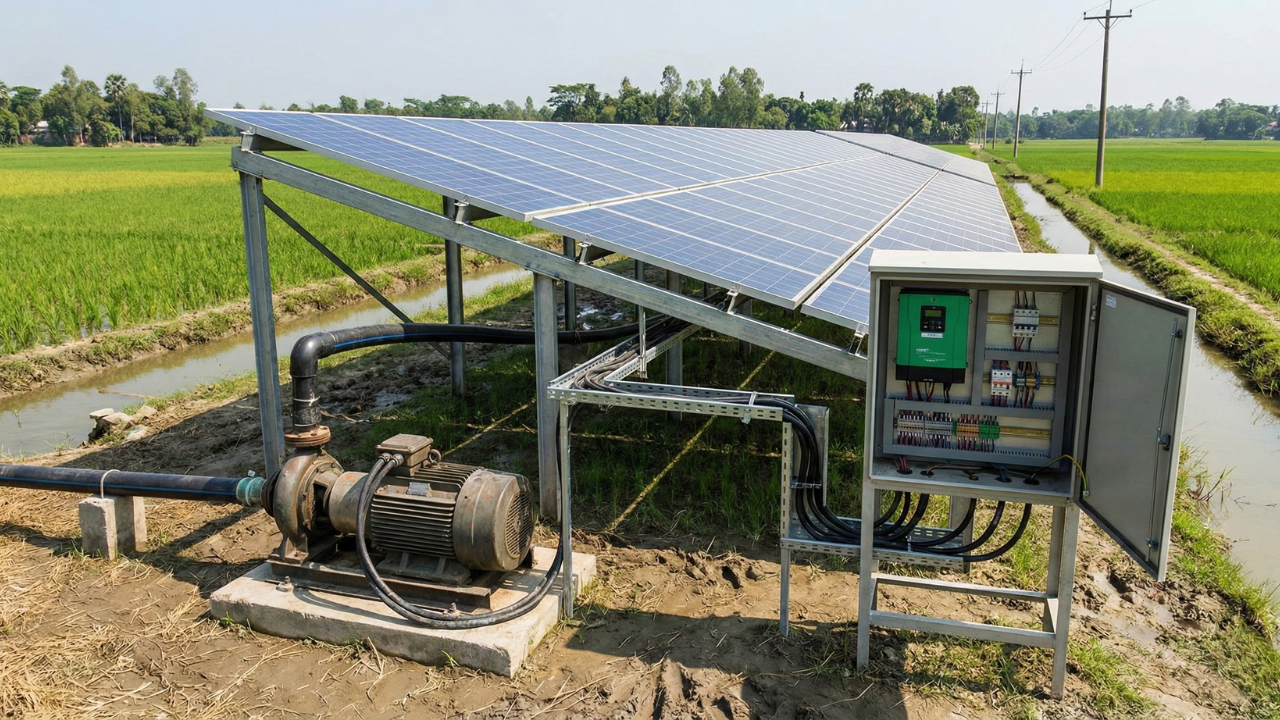
Agrivoltaics raises panels high enough, and spaces them widely enough, for crops to grow and farmers to work underneath. Partial shade can reduce heat stress on some crops and cut water evaporation, while the panels produce electricity for irrigation or the grid.
The first Bangladeshi pilots
- November 2025: the Power Division and GIZ launched an agrivoltaics pilot programme and a national working group on agrivoltaics and floating solar, with Fraunhofer ISE and IDCOL presenting.
- August 2026: Bangladesh’s first grid-connected agrivoltaics pilot — 49.6 kWp at Wave Foundation’s solar irrigation site in Chuadanga — began operation, growing green chillies, with vegetables and rice planned next. IDCOL financed 80% of installation costs through a KfW capital grant, with support from the EU and Germany.
Data from the pilot on crop yields and operation will inform national policy.
Floating solar: ponds, beels and lakes
- Potential: an IFC study screened 323 water bodies larger than 25 acres and estimated about 11 GWp of floating solar potential, most of it on Kaptai Lake.
- Proof on the ground: a 2.3 MW floating plant on a 22,000 m² fish pond supplies the Nawab Auto Rice Mill and exports surplus to the grid, while fish farming continues below.
- Cooling bonus: water keeps panels cooler, which improves their efficiency.
What the new law says
The Special Solar Power Installation Ordinance, 2026 covers projects of up to 5 MW on rooftops, courtyards, unused land, tea gardens and water bodies, and explicitly includes floating solar and agrivoltaics. OPEX projects use a standard three-party agreement. See the ordinance explained.
Design essentials
| Topic | Agrivoltaics | Floating solar |
|---|---|---|
| Height and spacing | High enough for people and machines; row spacing for light | Walkways between float rows for maintenance |
| Crop or fish fit | Shade-tolerant crops; test before scaling | Keep enough open water for oxygen and fish health |
| Water level | Design above flood level | Anchoring for large monsoon water-level changes |
| Wind | Cyclone-rated structures | Mooring designed for storm loads |
| Corrosion | Galvanised or aluminium structures | UV-stable floats, marine-grade fixings and cables |
| Safety | Cable protection from animals and machinery | Waterproof connectors and earthing |
Who should consider it
- Farms already using solar irrigation — see solar pump vs diesel.
- Fish farms and hatcheries with ponds next to a load.
- Rice mills, cold storage and agro-processors near water bodies.
- Tea gardens, which the ordinance names explicitly.
See our Agriculture Solar Pump service and solar for poultry and dairy farms.
Frequently Asked Questions
What is agrivoltaics?
Agrivoltaics means installing solar panels high above farmland so crops can grow and farmers can work underneath. The same land produces food and electricity.
Is there agrivoltaics in Bangladesh?
Yes. Bangladesh’s first grid-connected agrivoltaics pilot, 49.6 kWp, began in Chuadanga in August 2026, growing green chillies under the panels, with support from the EU, Germany, GIZ, Fraunhofer ISE and IDCOL.
How much floating solar can Bangladesh install?
An IFC study of 323 water bodies larger than 25 acres estimated about 11 GWp of floating solar potential, most of it on Kaptai Lake.
Can fish farming continue under floating solar?
Yes, with good design. A 2.3 MW floating plant on a fish pond in Bangladesh supplies a rice mill and the grid while fish farming continues.
Does the new solar ordinance cover agrivoltaics and floating solar?
Yes. The Special Solar Power Installation Ordinance, 2026 covers projects of up to 5 MW, including floating solar and agrivoltaics, on rooftops, unused land, tea gardens and water bodies.
Have a Pond, Farm or Tea Garden?
We assess the site, the water or crop conditions and the load, then design a dual-use solar system that keeps your farm productive.
Questions? Call or WhatsApp +880 1805-208117 or email info@frostecsolarpowers.com. Head office: Suite 708/B, Level 7, Zaman Tower, 37/2 Purana Paltan, Dhaka 1000. Figures in this article are indicative and approximate; final values depend on your site survey, design and the manufacturer terms of the equipment supplied.