
For a farmer, irrigation is often the largest cash cost of the Boro season — and almost all of it is diesel. With diesel at Tk 135 per litre since September 2026 and fuel supply under pressure, solar irrigation has moved from an experiment to a practical choice.
Updated October 2026 · Written and reviewed by the Frostec Solar Powers engineering team
- Bangladesh has about 1.6 million groundwater irrigation pumps; roughly 80% run on diesel.
- On 9 September 2026 the Prime Minister told Parliament that diesel irrigation pumps will be shifted to solar within five years.
- Diesel rose to Tk 135 per litre in September 2026, making every hour of diesel pumping more expensive.
- A solar pump’s fuel cost is zero, and the sunniest months (February–April) match the Boro season.
- Size from water need, pumping head and pump power — then plan for responsible groundwater use.
Why solar irrigation matters now
Bangladesh has about 1.6 million groundwater irrigation pumps, and around 80% of them run on diesel, according to IWMI. An IEEFA study reported in August 2026 counted about 3,556 solar irrigation pumps in operation and estimated that replacing one-third of diesel pumps could save about 862 million litres of diesel and nearly $244 million in imports every year.
On 9 September 2026, Prime Minister Tarique Rahman told Parliament that all diesel-operated irrigation pumps will be gradually shifted to solar within the next five years. Meanwhile, diesel went up by Tk 20 to Tk 135 per litre on 20 September 2026.
How a solar pump works
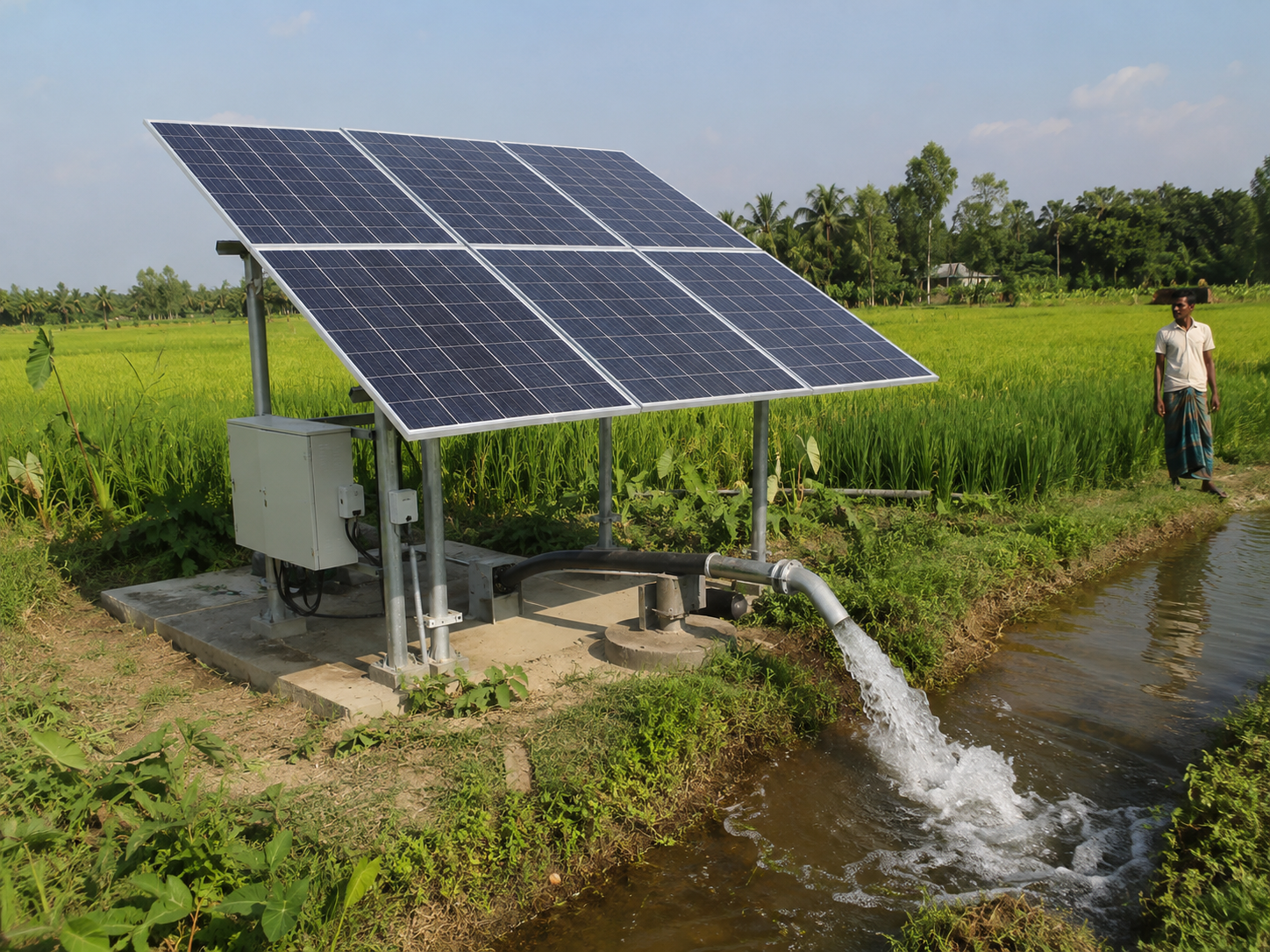
Solar panels feed a solar pump controller (a variable-frequency drive), which runs a submersible or surface pump. When sunlight is strong the pump runs faster; in weaker light it slows down. Most systems need no battery — the water itself is the “storage”, held in the field or a reservoir. Typical parts are panels, a mounting structure, the controller, the pump, pipes and protection with earthing.
Sizing a solar pump — step by step
- Daily water need: field area × water depth required per day, including channel losses. Boro rice needs the most water.
- Total head: water level depth + lift to the outlet + pipe friction losses. Deeper water tables need more power for the same flow.
- Pump selection: choose the pump whose curve delivers the required flow at that head during about 6–7 good sun hours.
- Array size: solar arrays for pumps are usually sized at about 1.3–1.5 times the motor rating to cover morning, evening and hazy-day losses. A 5 HP (3.7 kW) pump typically needs around 5–5.5 kW of panels.
- Site check: shade-free location, flood level, theft protection and a strong foundation.
Diesel vs solar: an example
Use your own fuel log for an exact comparison. As an illustration, a 5 HP diesel pump using about 0.9 litre per hour, running 6 hours a day for a 110-day Boro season, burns about 590 litres. At Tk 135 per litre that is roughly Tk 80,000 of fuel in one season — before engine repairs, oil changes and the time spent fetching diesel.
| Diesel pump | Solar pump | |
|---|---|---|
| Fuel cost | Rises with every price change | Zero |
| Running cost | Oil, filters, engine repairs | Panel cleaning, periodic checks |
| Supply risk | Shortages and rationing | None during sunny months |
| Night pumping | Possible | Not without battery or grid |
| Upfront cost | Lower | Higher — recovered through fuel savings |
Dhaka-region sunlight averages about 4.2 kWh/m² a day, from about 3.25 in December to over 5 in April — the Boro months are among the sunniest of the year.
Irrigate responsibly: protect groundwater
Because solar pumping costs almost nothing to run, there is a risk of over-pumping. IWMI warns that most irrigation supports water-intensive Boro rice in areas where groundwater is already under stress. Good practice includes:
- Alternate wetting and drying (AWD) in rice fields instead of continuous flooding.
- Buried or lined pipes to cut channel losses.
- Timers or float switches so the pump stops when the field or tank is full.
- Sizing to the real command area, not the largest possible pump.
Make the system work all year
Outside the irrigation season the panels can power other loads: aman supplementary irrigation, fish ponds, rice husking or a community fee-for-service model where several farmers share one pump. Where grid connection is possible, SREDA guidelines have allowed surplus electricity from solar irrigation systems to be sold to the grid — check current terms with your utility.
See our Agriculture Solar Pump service for irrigation and fish-farm systems. For larger farms and agro-processing, see our industrial solar and CAPEX vs OPEX guides.
Frequently Asked Questions
How much does a solar irrigation pump save compared with diesel?
It removes the fuel cost entirely. For example, a 5 HP diesel pump running 6 hours a day for a 110-day Boro season can burn about 590 litres — roughly Tk 80,000 at Tk 135 per litre — plus engine maintenance.
What size solar panel is needed for a 5 HP pump?
Typically about 5–5.5 kW of panels, because pump arrays are usually sized at 1.3–1.5 times the motor rating. The exact size depends on water depth, flow and pipe losses.
Does a solar pump need a battery?
Usually not. The pump runs during sunshine and water is stored in the field, a tank or a reservoir. Batteries add cost and are only needed for night pumping.
Is the government replacing diesel irrigation pumps with solar?
On 9 September 2026 the Prime Minister told Parliament that diesel-operated irrigation pumps will be gradually shifted to solar within five years. Details of support for farmers have not yet been announced.
Does solar irrigation harm groundwater?
It can if pumps run unnecessarily. Using alternate wetting and drying, lined channels, timers and correct sizing keeps water use sustainable.
Switch Your Pump from Diesel to Solar
Tell us the pump size, water depth and command area. We will design the array, controller and structure — and show the fuel savings for your field.
Questions? Call or WhatsApp +880 1805-208117 or email info@frostecsolarpowers.com. Figures in this article are indicative and approximate; final values depend on your site survey, design and the manufacturer terms of the equipment supplied.