
Panels rarely fail in a storm — structures do. When wind flows over a roof, it does not just push on the panels; it lifts them. In a country where cyclones cross the coast almost every year, the mounting structure is the part of a solar system that decides whether it survives.
Updated October 2026 · Written and reviewed by the Frostec Solar Powers engineering team
- The Bangladesh National Building Code (BNBC 2020) specifies basic wind speeds of roughly 195 km/h for Dhaka, rising to about 245–260 km/h around Cox’s Bazar and the coastal islands (as summarised from the code).
- Wind uplift is strongest at roof edges and corners; layouts should keep clearance from edges.
- Use hot-dip galvanised steel or structural aluminium, with stainless or galvanised fasteners.
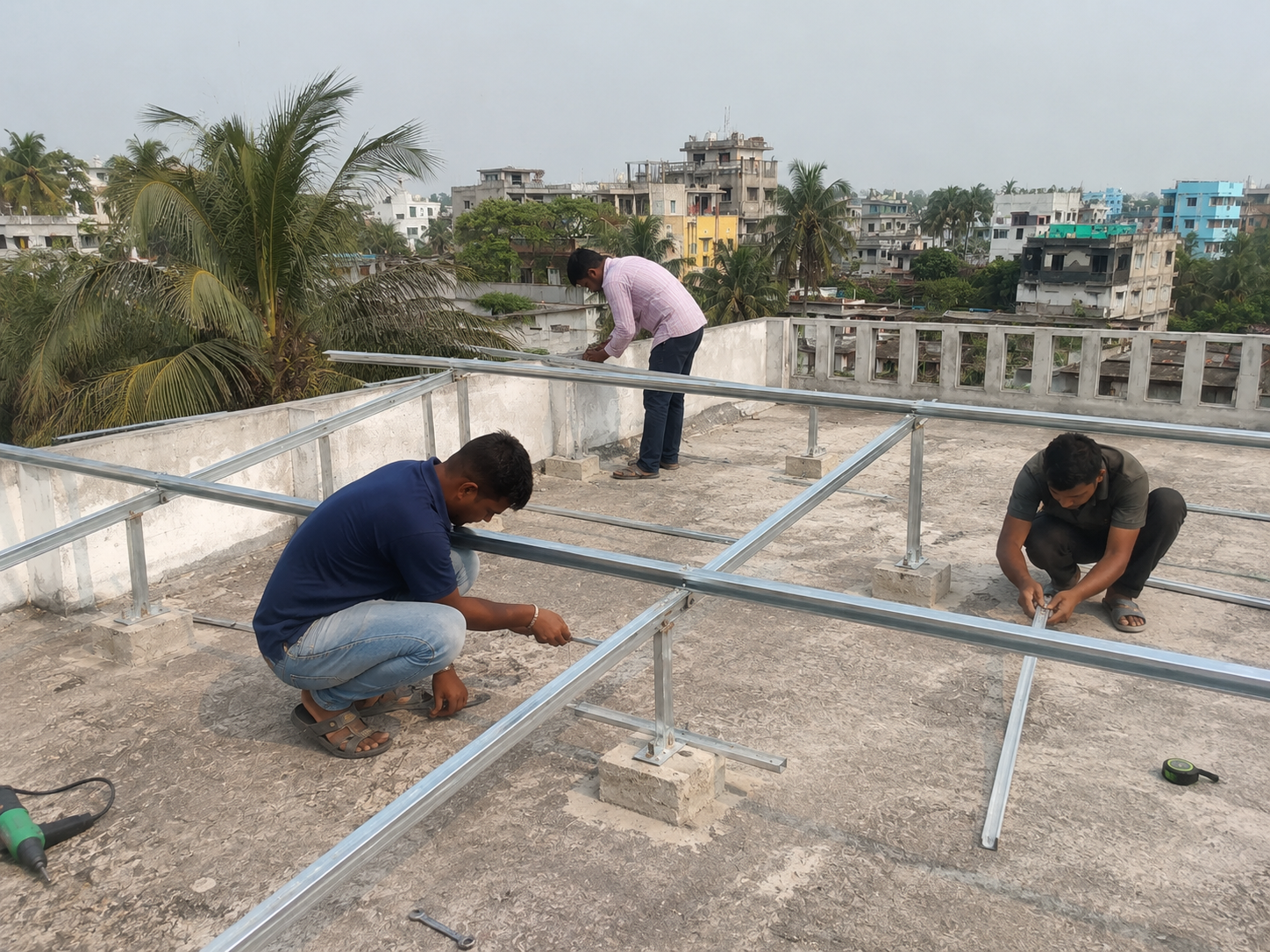
- Anchoring must suit the roof: chemical anchors or cast footings on concrete, purlin fixing on steel sheds — without damaging waterproofing.
- Inspect before (April, October) and after every major storm.
How wind attacks a solar array
- Uplift: wind flowing over and under tilted panels creates suction that pulls them upward.
- Edge and corner effects: wind pressure is highest near roof edges and corners.
- Vibration and fatigue: repeated gusts loosen bolts and clamps over time.
- Flying debris: poorly fixed panels become dangerous projectiles.
What the building code requires
BNBC 2020 sets a basic wind speed map for Bangladesh. Summaries of the code give values of about 195 km/h for Dhaka, 195–210 km/h for Sylhet, 225–245 km/h for Chattogram, 245–260 km/h for Cox’s Bazar and about 260 km/h for coastal islands. Design loads also depend on building height, exposure and roof shape, so the structure should be calculated for each site rather than copied from another project.
Design choices that reduce wind load
| Choice | Effect |
|---|---|
| Lower tilt (about 10–15°) | Less uplift, and rain still cleans the glass |
| Edge clearance (around 1 m) | Keeps panels out of the highest-pressure zones and gives safe working space |
| Continuous rows tied together | Shares load across the structure |
| Modest raised height | Very high frames catch more wind and need stronger bracing |
Materials and fixings
- Steel: hot-dip galvanised sections of adequate thickness — painted mild steel rusts quickly in humid and coastal air.
- Aluminium: structural-grade anodised rails resist corrosion and are light.
- Fasteners: stainless steel or hot-dip galvanised; avoid mixing metals that cause galvanic corrosion without isolation.
- Module clamps: installed at the manufacturer’s clamping zones and tightened to specified torque.
Anchoring to different roofs
| Roof | Typical method | Watch out for |
|---|---|---|
| Concrete (RCC) slab | Chemical anchors into the slab or cast concrete footings | Waterproofing around penetrations; slab load capacity |
| Steel shed (CGI / metal sheet) | Rails fixed to purlins or seam clamps | Purlin strength, sheet condition and sealing |
| Ground or farm | Concrete piers or driven piles | Flood level and soil — see agrivoltaics |
Ballast-only systems need careful calculation on high-wind sites; many Bangladeshi roofs are better served by anchored designs. Read more in the hidden engineering behind a rooftop array.
Inspection schedule
- Before cyclone seasons (April and October): check bolt tightness, clamps, corrosion and footings.
- After every major storm: look for shifted panels, cracked glass, loose clamps and damaged cables.
- Every year: check waterproofing around footings and anchors.
Combine this with your earthing check — see lightning protection and earthing — and our AMC plans.
Frequently Asked Questions
Can solar panels survive a cyclone in Bangladesh?
Yes, if the structure is designed for the site’s wind load, properly anchored and maintained. Most storm failures are caused by weak structures and loose fixings, not the panels themselves.
What wind speed should a solar structure be designed for in Bangladesh?
It depends on location and building. Summaries of BNBC 2020 give basic wind speeds of about 195 km/h for Dhaka and up to about 260 km/h on coastal islands; each site should be calculated.
Which material is best for solar mounting structures?
Hot-dip galvanised steel or structural anodised aluminium, with stainless or galvanised fasteners. Painted mild steel corrodes quickly in Bangladesh’s humid climate.
Do solar mounting footings damage the roof?
Not if they are designed and sealed correctly. Anchors and footings must be installed with proper waterproofing around every penetration.
How often should a solar structure be inspected?
Before each cyclone season (April and October), after every major storm, and at least once a year.
Is Your Structure Ready for the Next Cyclone?
We calculate wind loads for your site and inspect existing structures, fixings and waterproofing.
Questions? Call or WhatsApp +880 1805-208117 or email info@frostecsolarpowers.com. Head office: Suite 708/B, Level 7, Zaman Tower, 37/2 Purana Paltan, Dhaka 1000. Figures in this article are indicative and approximate; final values depend on your site survey, design and the manufacturer terms of the equipment supplied.