
“25-year warranty” is the most repeated phrase in solar sales — and one of the most misunderstood. Every panel actually carries two different warranties, and knowing the difference protects you when something goes wrong.
Updated October 2026 · Written and reviewed by the Frostec Solar Powers engineering team
- The product warranty (typically 12 years) covers manufacturing defects; the performance warranty (typically 25–30 years) guarantees a minimum output.
- Current N-type warranties typically promise ≤ 1% loss in year one, about 0.4% a year after, ending near 87–89% at year 30.
- A performance claim needs proof: your panels’ flash-test data and a calibrated field measurement.
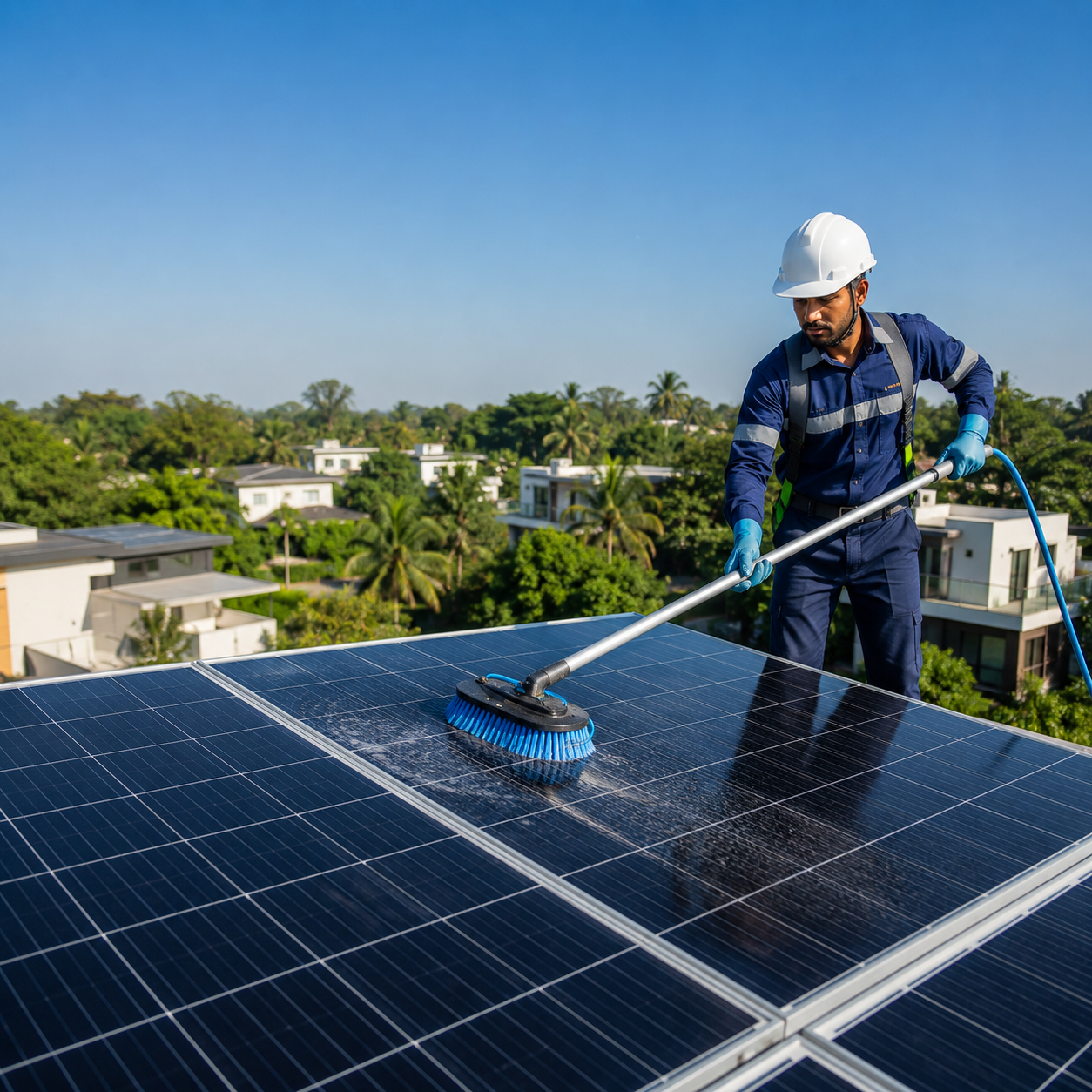
- Correct cleaning — soft brush, clean water, safety gear, as pictured — protects both output and warranty.
The two warranties inside “25 years”
| Product warranty | Performance (power) warranty | |
|---|---|---|
| Typical duration | 12 years (some lines longer) | 25–30 years |
| Covers | Manufacturing defects: delamination, frame or glass failure, junction-box faults, defect-related hotspots | Minimum output — e.g. ≥ 87.4% of nameplate after 30 years on JA DeepBlue 4.0 Pro |
| Remedy | Repair or replacement of the panel | Replacement or compensation if measured output falls below the guaranteed curve |
When a seller says “25-year warranty”, they almost always mean the performance warranty. If a frame corrodes in year 14, the performance warranty does not help — that was a product-warranty issue, and it has expired.
What the performance warranty really promises
Current N-type flagship lines from Jinko, LONGi and JA Solar warrant about 1% loss in the first year and about 0.4% per year after, over 30 years. In plain numbers, a 600 W panel is guaranteed to deliver roughly 520–535 W under standard test conditions after 30 years. Two things to know:
- Claims need measurement. You need the panel’s factory flash-test result and a calibrated field measurement showing output below the curve — not just a higher electricity bill.
- Degradation is rarely the real problem. Most underperforming systems in Bangladesh lose output to dust, shading, loose connections or inverter faults — none of which is a panel warranty issue.
Cleaning: the cheapest performance warranty
Dust and bird droppings can reduce output noticeably in dry months — far more than a year of degradation. The photo above shows the right method: a soft brush, clean water, and a technician working with a helmet and safety harness. Avoid abrasive pads, detergents, high-pressure jets and walking on modules; these can scratch the anti-reflective coating or cause micro-cracks, and that damage is not covered.
- Clean every 2–4 weeks in dry, dusty months; less in the monsoon.
- Clean early morning or late afternoon, not on hot glass at noon.
- Check for cracked glass, discoloured cells or hot spots while cleaning.
What voids a panel warranty
- Installation outside the manufacturer’s instructions (wrong clamping zones, unsupported spans).
- Physical damage, drilling or modifying frames.
- Mismatched or non-genuine connectors.
- Grey-market or relabelled stock without a traceable supply chain.
The Bangladesh question: who actually honours it?
A manufacturer warranty is only as useful as the channel that processes it. Buy from authorised distributors, keep the invoice and serial numbers, and make sure your installer will coordinate claims. At Frostec we document every component’s warranty at handover and manage claims with the brand or distributor — see Warranty & Handover: What You Receive. All warranties remain subject to the manufacturer’s own terms.
Warranty vs price: the honest trade-off
A longer warranty on paper is worth little without genuine stock and a working claim channel. A slightly cheaper panel from an untraceable source can cost far more if it fails in year six. Compare brands in Jinko vs LONGi vs JA Solar.
Frequently Asked Questions
Do solar panels really last 25 years?
Quality panels typically keep producing for 25–30 years, gradually losing output. Current N-type warranties guarantee about 87–89% of original output after 30 years, subject to manufacturer terms.
Is the battery or inverter covered by the panel’s 25-year warranty?
No. Inverters and batteries have their own manufacturer warranties, often up to 10 years for quality units, subject to terms.
How often should I clean my solar panels?
About every 2–4 weeks in dry, dusty months and less often during the monsoon, using clean water and a soft brush.
What warranty should I expect from the installer?
A written workmanship or service warranty for the installation itself. Frostec provides a 1-year service warranty, with paid and AMC service afterwards.
Protect Your Panels and Your Warranty
Ask about our AMC plans: scheduled cleaning, inspection and performance checks with records you can use for any future claim.
Questions? Call or WhatsApp +880 1805-208117 or email info@frostecsolarpowers.com. Head office: Suite 708/B, Level 7, Zaman Tower, 37/2 Purana Paltan, Dhaka 1000. Figures in this article are indicative and approximate; final values depend on your site survey, design and the manufacturer terms of the equipment supplied.