
Most hybrid system problems we are called to fix have nothing to do with the panels on the roof. They start in the room where the inverter and batteries sit: too hot, too dusty, cables too thin, no proper isolation. A well-planned power room makes the system safer, longer-lasting and easier to service.
Key takeaways
- Choose a cool, dry, ventilated location out of direct sun and rain; heat shortens battery and inverter life.
- Follow the manufacturer’s clearances around the inverter so it can shed heat.
- Battery cables carry high current: size them correctly, keep them short and use proper lugs and a DC breaker or fuse.
- Install a distribution cabinet with breakers, surge protection and clear labels for each circuit.
- Lithium (LiFePO4) batteries need correct BMS communication and settings in the inverter.
Choosing the right location
The ideal spot is indoors or under cover, on a solid wall, with airflow and space to work. In Bangladeshi homes this is often a ground-floor utility room, a stair landing or a garage wall; in offices and clinics, a dedicated electrical room.
- Out of direct sunlight and rain, away from kitchens and water tanks.
- Good ventilation — an exhaust fan or louvres if the room is small.
- Close to the main distribution board to keep AC cables short.
- Reasonable distance from the roof array to limit DC cable length.
- Not in a bedroom: inverters make fan noise, and batteries should not be where people sleep.
- Floor level above any flood or water-logging risk.
Heat, clearances and dust
Inverters and batteries both produce heat and both suffer when they run hot. Inverter manuals specify clear space above, below and to the sides so cooling air can circulate; boxing an inverter into a cupboard is a common cause of derating and early failure. Many LiFePO4 batteries specify a charging temperature range of roughly 0 °C to 45–55 °C — always check the datasheet for the battery you buy.
Wall layout that is easy to service
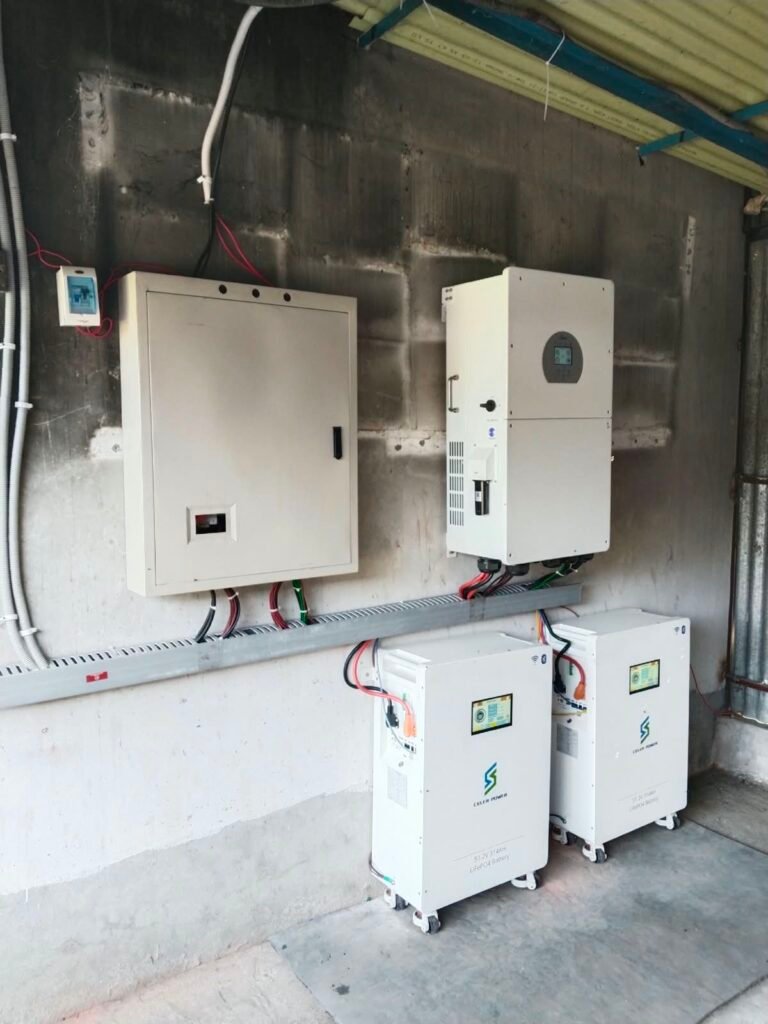
A tidy layout is not just about looks. When every cable is labelled and runs in trunking, a technician can isolate and test the system quickly and safely.
Inverter at eye level
The display and isolators are easy to read and operate.
Distribution cabinet beside it
AC breakers, surge protection and the changeover to backup loads in one place.
Batteries on the floor
Heavy units sit on a solid, level floor, close to the inverter with short cables.
Cable trunking
DC, AC and communication cables separated, protected and labelled.
Protection you should see
A safe hybrid installation includes protection on every side of the inverter.
| Side | What should be installed | Why |
|---|---|---|
| PV (from roof) | DC isolator, DC surge protection, string fuses where needed | Safe shutdown of the array and protection from lightning surges |
| Battery | Correctly rated DC breaker or fuse, properly crimped lugs, correct cable size | Battery short-circuit current is very high |
| AC output | Breakers for backup loads, AC surge protection, RCD where required | Protects wiring and people |
| Grid input | Breaker and, for on-grid export, utility-approved metering | Safe connection to the grid |
| Earthing | Inverter, cabinet and frames bonded to the system earth | Fault current has a safe path |
Our earthing and lightning protection guide explains the earthing side in more depth.
Battery settings and communication
Modern lithium batteries have a battery management system (BMS) that talks to the hybrid inverter over CAN or RS485. When that link and the inverter’s battery settings are correct, the inverter charges and discharges within the battery’s safe limits. When they are wrong, the battery can be over-stressed or the system can trip unexpectedly. Commissioning should always include checking the communication, charge and discharge limits and the backup reserve.
Frequently asked questions
Where should I install a solar hybrid inverter at home?
On a solid wall in a cool, dry, ventilated place out of direct sun and rain, close to the main distribution board, with the manufacturer’s clearances around it. Avoid bedrooms and closed cupboards.
Can lithium solar batteries be kept indoors?
LiFePO4 batteries are commonly installed indoors in a ventilated utility or electrical room, following the manufacturer’s installation and temperature requirements.
Why does my inverter get hot and reduce output?
Usually because it lacks ventilation or clearance, or its heat sink is clogged with dust. Inverters reduce output to protect themselves when they overheat.
What size cable is needed between inverter and battery?
It depends on the inverter’s maximum battery current and the cable length. Because currents are high, the cable must be sized by the designer and fitted with proper lugs and a DC breaker or fuse.
Can I use my old IPS batteries with a new hybrid inverter?
Sometimes, but it is often better to move to lithium. If old batteries are reused, the inverter must be set for that battery type, and their remaining capacity should be tested first.
Upgrading to a hybrid system?
We design the power room, protection and battery settings as carefully as the roof.
Keep reading
Written and reviewed by the Frostec Solar Powers engineering team · Updated November 2026. Photos are from Frostec installations. Figures are indicative; final values depend on the site survey, system design and the manufacturer terms of the equipment supplied. Questions? Call or WhatsApp +880 1805-208117.