
“I live in a flat — can I even have solar?” We hear this every week. The answer is yes, but in an apartment building the roof is shared, so the decision and the design must be shared too. The simplest and most profitable starting point is usually the building’s common meter.
Updated October 2026 · Written and reviewed by the Frostec Solar Powers engineering team
- The roof is common property: an owners’ association or building committee resolution is the first step.
- Solar on the common meter (lift, water pump, stair and parking lights, CCTV) is the simplest model and cuts the monthly service charge for everyone.
- Per-flat systems are possible but need separate cable routes and meters for each flat.
- New net-metering connections for buildings with at least 1,000 sq ft of usable roof now require rooftop solar.
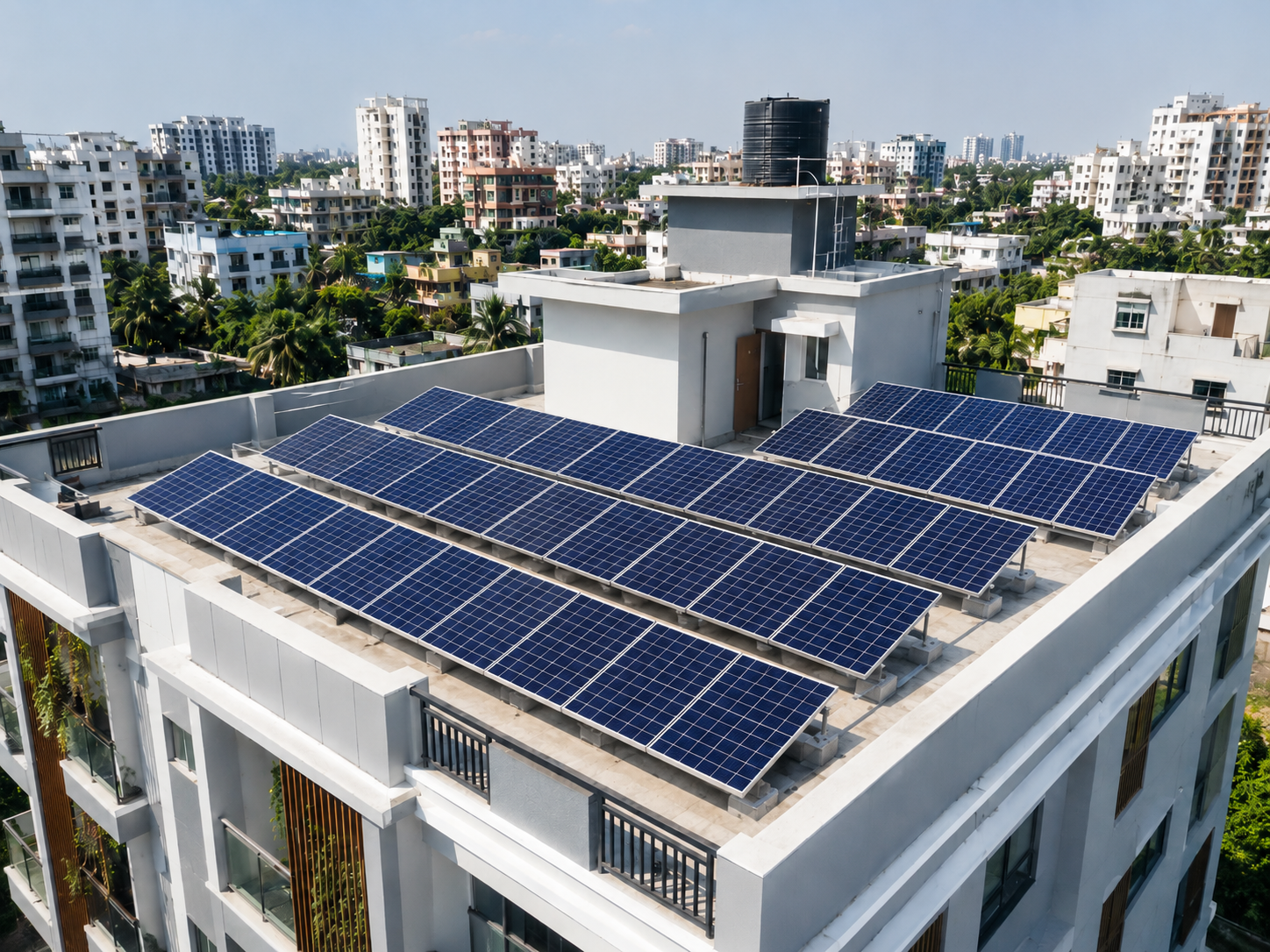
- Raised mounting frames keep the roof usable for drying clothes, gatherings and tank access.
Three ways an apartment building can use solar
| Model | How it works | Best for |
|---|---|---|
| 1. Common-meter solar | One system connected to the building’s common meter; it powers the lift, pumps, lights and security. | Almost every building — simplest approvals and wiring |
| 2. Allocated roof per flat | Each flat gets a share of panels with its own inverter or string, cable route and net meter. | Buildings with large roofs and owners who want individual savings |
| 3. Hybrid backup for essentials | Solar plus battery on a backup board for the water pump, stair lights, CCTV and intercom. | Buildings suffering from load shedding |
Why the common meter is the best starting point
Water pumps, corridor and parking lights, CCTV and gate systems run every day, and much of that use is in daylight. A system on the common meter needs only one application, one inverter location and one net meter, and its savings reduce the service charge that every flat pays.
Example: a 6-storey building with 10 flats whose common meter uses about 900 units a month. A 10 kW on-grid system produces about 10 kW × 3.8 units × 30 days ≈ 1,140 units a month, enough to cover the common load on most days and export the rest under net metering. At about ৳10 per unit, that is worth roughly ৳9,000–11,000 a month. At Frostec’s indicative ৳32 per watt, the system costs about ৳3.2 lakh — around ৳32,000 per flat, recovered in roughly three years.
What the roof must allow
- Usable area: about 65–100 sq ft per kW including walkways — a clear 1,000 sq ft roof typically holds 7–12 kW.
- Obstacles: stair room, lift machine room, water tanks and lightning arresters cast shadows; the layout must avoid them, especially in winter when shadows are longest.
- Raised frames: mounting panels on a frame 7–8 ft high keeps the roof usable underneath and provides shade.
- Waterproofing and structure: footings must not damage the roof membrane, and the frame must be designed for cyclone wind loads.
- Access: safe access for cleaning without walking on panels.
The rules
Under the Power Division circular of December 2025, buildings with at least 1,000 sq ft of roof usable for 20 years must install rooftop solar when applying for a new net-metering connection. New buildings handed over by developers are therefore increasingly built with solar. Systems can be sized up to 100% of the meter’s sanctioned load. Details are in our rules explainer.
If the building adds battery storage and installs by 28 February 2027, exported surplus may earn Tk 10.50 per unit — see the incentive guide.
Making the decision as an association
- Get a site survey and proposal showing capacity, cost, savings and roof layout.
- Pass a written resolution in the owners’ association approving the roof use and cost sharing.
- Agree on cost sharing: equally per flat, or by flat size — the same basis as the service charge is easiest.
- Name a responsible person for monitoring, cleaning and the AMC contract.
- Apply for net metering for the common meter through nem.powerdivision.gov.bd.
Frequently Asked Questions
Can I install solar panels if I live in a flat?
Yes, with the agreement of the owners’ association, because the roof is shared. The simplest option is solar on the building’s common meter, which lowers everyone’s service charge. Individual allocations per flat are also possible.
How much solar can an apartment roof hold?
Roughly 65–100 sq ft of usable roof per kW. A clear 1,000 sq ft roof typically holds about 7–12 kW, depending on the stair room, tanks and shading.
How is the cost shared between flats?
Most associations share it the same way as the service charge — equally per flat or by flat size. A 10 kW common-meter system at about ৳3.2 lakh costs around ৳32,000 per flat in a 10-flat building.
Can solar run the lift during load shedding?
It is possible but needs a large inverter and battery. Most buildings keep the lift on the generator and put the water pump, lights, CCTV and intercom on a solar battery backup.
Will panels stop us from using the roof?
Not if they are installed on raised frames. Panels 7–8 ft above the roof leave space underneath for drying clothes, gatherings and tank access, and add shade.
Planning Solar for Your Building?
We survey the roof, prepare a proposal your association can vote on, and handle net-metering for the common meter.
Questions? Call or WhatsApp +880 1805-208117 or email info@frostecsolarpowers.com. Figures in this article are indicative and approximate; final values depend on your site survey, design and the manufacturer terms of the equipment supplied.