
Not every site has a good roof. Factories with old sheds, farms that need irrigation power and institutions with open land often have space on the ground instead. Ground-mounted solar can be easier to build, clean and expand than a rooftop system — but in Bangladesh it has to be designed for soft soil, heavy rain and floods.
Key takeaways
- Ground-mounted systems suit sites with free land and weak or shaded roofs.
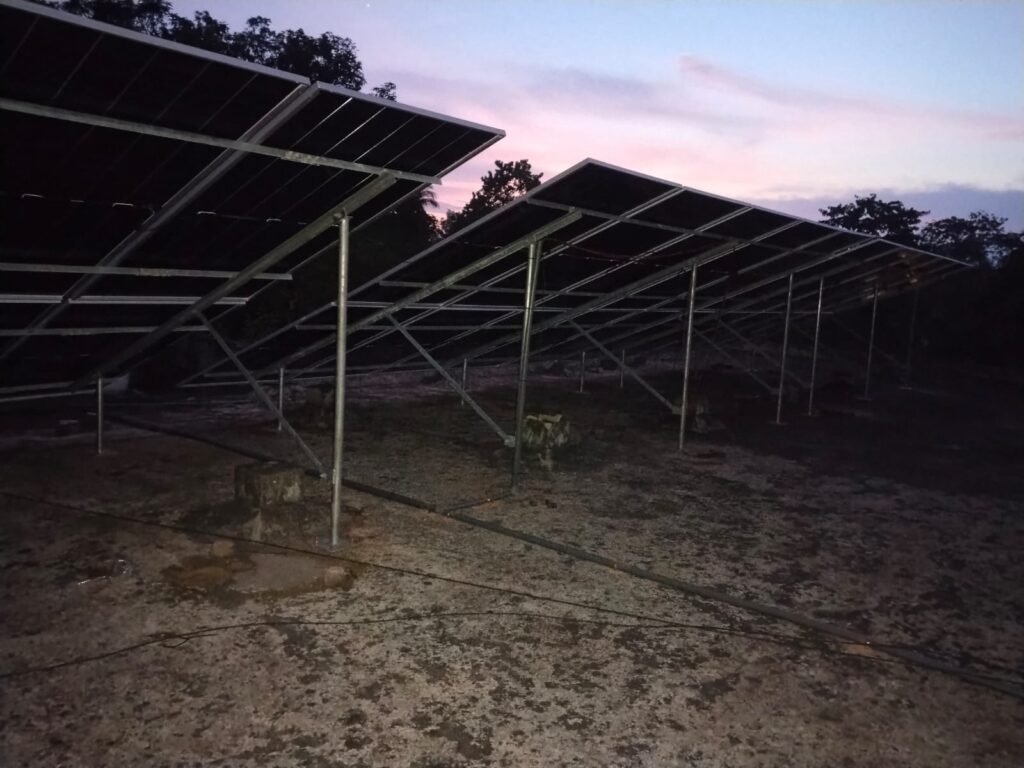
- The lowest panel edge must sit above the highest expected flood level, with margin.
- Foundations are chosen for the soil: concrete footings, piles or screw piles.
- Raised structures can leave land underneath usable for grazing, crops or storage.
- Plan fencing, security, earthing and buried cable routes from the start.
When ground-mounting makes sense
Weak or old roofs
Sheds and older buildings that cannot carry an array safely.
Not enough roof
Loads that need a bigger system than the roof can hold.
Irrigation and farms
Solar placed near pumps and fields, with short cable runs.
Institutions with land
Schools, madrasas, hospitals and factories with open, unshaded ground.
Large utility plants in Bangladesh are also ground-mounted — for example, a 68 MW plant in Sirajganj was commissioned in 2024 — but the same principles apply at small scale: height above flood water, sound foundations and good drainage.
Flood height comes first
In much of Bangladesh, ground that is dry in winter can be under water in the monsoon. The design starts with one question: how high has water reached here? Local knowledge, marks on nearby buildings and records from neighbours all help. The lowest edge of the panels, and every inverter, combiner box and cable joint, must sit above that level with a safety margin.
Foundations and structure
| Foundation | How it works | Suits |
|---|---|---|
| Concrete pad / pier footings | Steel columns set on or into cast concrete footings | Most small and medium sites; firm soil |
| Driven or bored piles | Columns or piles driven or cast deeper into the ground | Softer soils, larger arrays, higher wind loads |
| Screw piles | Helical steel piles screwed into the ground | Quick installation where soil conditions allow |
A soil check guides the choice. Structures are hot-dip galvanised for corrosion resistance, braced for wind, and set at a tilt that balances generation with rain run-off.
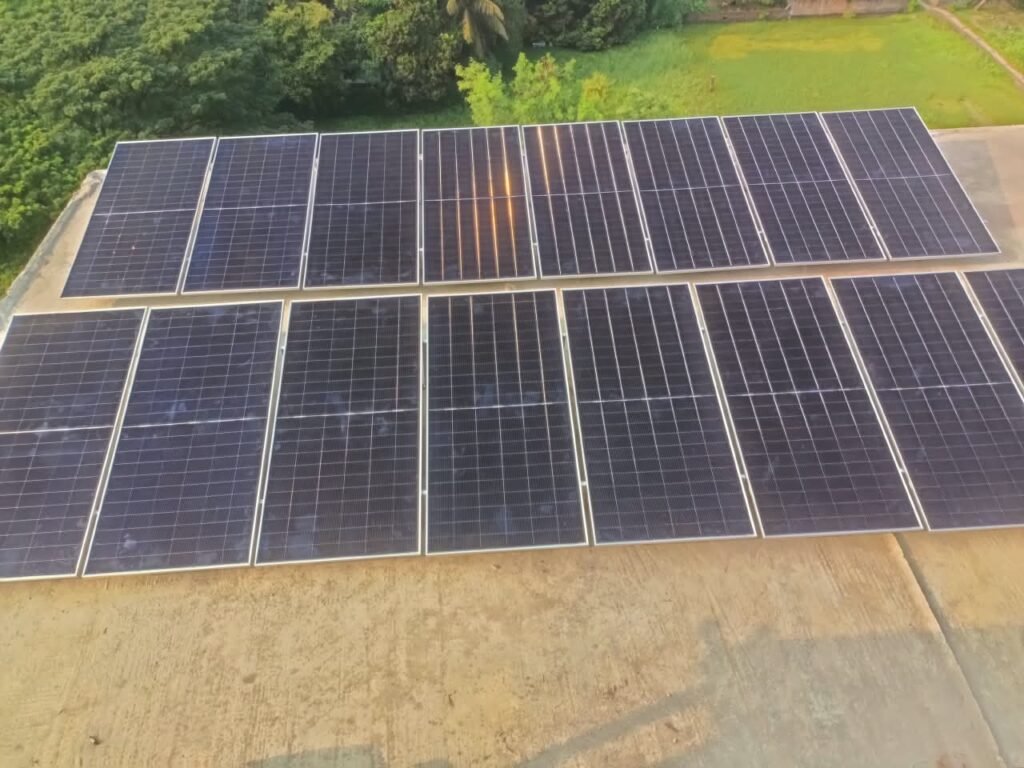
Using the land underneath
A raised structure does not have to take land out of use. Depending on height and spacing, the ground underneath can be used for grazing, shade-tolerant crops, nurseries or storage. This idea, known as agrivoltaics, is covered in our guide to agrivoltaics and floating solar.
Security, earthing and cables
- Fencing and gates to keep out animals and protect against theft.
- Buried cables in proper conduit at a safe depth, with route markers.
- Earthing for every structure row, bonded to the system earth.
- Lightning protection where the array is the tallest structure around.
- Access paths between rows for cleaning and inspection.
- Drainage so water does not pool around footings.
Frequently asked questions
Is ground-mounted solar better than rooftop solar?
Neither is always better. Ground-mounted systems suit sites with free land and weak or limited roofs, and they are easier to clean and expand. Rooftop systems use space that is otherwise idle.
How high should ground-mounted solar panels be in Bangladesh?
High enough that the lowest panel edge and all electrical equipment sit above the highest flood level recorded at the site, with a safety margin, and high enough for any planned use of the land underneath.
What foundation is used for ground-mounted solar?
Common options are concrete footings, driven or bored piles and screw piles. The choice depends on the soil, the size of the array and the wind load.
Can I farm under ground-mounted solar panels?
Often yes, if the structure is raised and spaced for it. Grazing and shade-tolerant crops are common choices; the design must allow for this from the start.
Does ground-mounted solar need fencing?
Yes, in most cases. Fencing protects the system from animals, accidental damage and theft, and keeps people away from live equipment.
Have land but not a good roof?
We survey the soil, flood history and layout before designing a ground-mounted system.
Keep reading
Written and reviewed by the Frostec Solar Powers engineering team · Updated November 2026. Photos are from Frostec installations. Figures are indicative; final values depend on the site survey, system design and the manufacturer terms of the equipment supplied. Questions? Call or WhatsApp +880 1805-208117.