
Every year, lightning kills hundreds of people in Bangladesh and destroys countless electrical appliances. A rooftop solar array — a large metal structure on the highest point of a building, wired straight into your distribution board — must be designed with lightning in mind.
Updated October 2026 · Written and reviewed by the Frostec Solar Powers engineering team
- Bangladesh declared lightning a natural disaster in 2016; official data record 243–427 deaths a year between 2016 and 2025.
- Lightning activity peaks from mid-April to early June; the north-east (Sylhet, Sunamganj) is the worst affected.
- Most solar damage comes from induced surges from nearby strikes, not only direct hits.
- Every system needs proper earthing, equipotential bonding of frames and surge protection devices (SPDs) on both DC and AC sides.
- Earthing and SPDs should be inspected every year before the pre-monsoon storm season.
Lightning in Bangladesh: the numbers
| Year | Lightning deaths (DDM data) |
|---|---|
| 2016 | 391 |
| 2018 | 388 |
| 2020 | 401 |
| 2021 | 427 |
| 2023 | 322 |
| 2025 | 243 |
At least 218 deaths were reported between January and mid-June 2026. Deaths peak from mid-April to early June, during the boro harvest, and are highest in the north-eastern Sylhet region.
How lightning damages solar systems
- Direct strike: rare, but can damage panels, cables and the structure.
- Induced surges: a strike hundreds of metres away induces high voltages in long DC cables — the most common cause of inverter and charge-controller failure.
- Grid-side surges: strikes on distribution lines travel into the building through the AC side.
- Poor earthing: without a low-resistance path, surge energy flows through equipment instead.
What a protected system includes
| Element | Purpose |
|---|---|
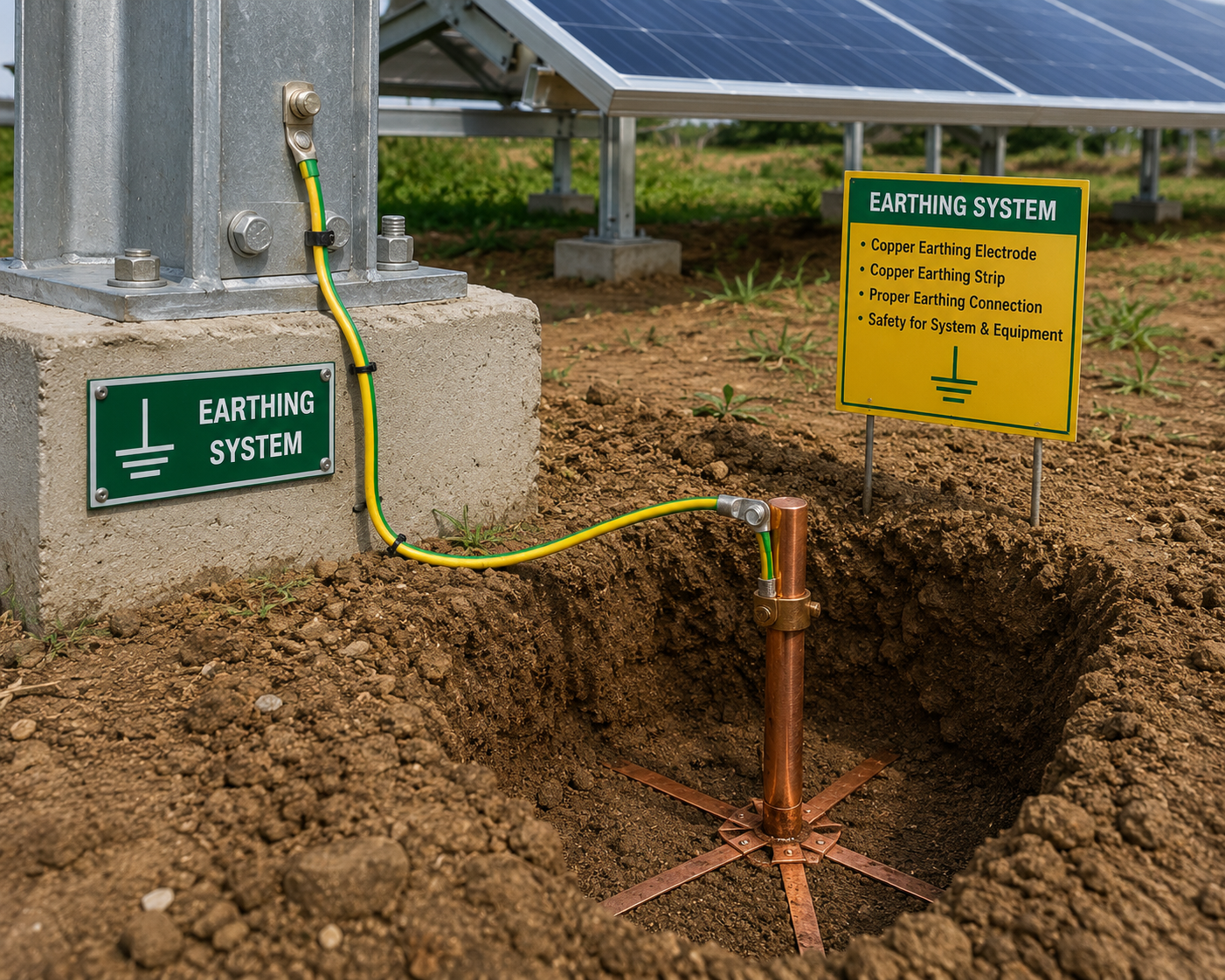
| Earth electrodes and earth pit | Low-resistance path to ground, tested and documented |
| Equipotential bonding | All frames, rails and metal parts connected so no dangerous voltage difference appears |
| DC surge protection (Type 2, sometimes Type 1+2) | Protects inverter inputs from induced surges on panel strings |
| AC surge protection | Protects the inverter and building wiring from grid surges |
| Lightning protection system (where required) | Air terminals and down conductors for buildings at risk of direct strikes, with safe separation from the array |
| Cable routing | Positive and negative run together to minimise loop area and induced voltage |
International references include IEC 62305 (lightning protection), IEC 61643 (surge protective devices) and IEC 60364-7-712 (PV installations). Equipment for net metering must meet BSTI and SREDA standards.
Common mistakes we find
- Frames left unbonded, or bonded with thin wire that corrodes.
- No DC SPD, or an AC-rated device used on the DC side.
- SPDs not replaced after they have operated.
- One shallow earth rod in dry soil, never tested.
- Long, separated positive and negative cable runs forming large loops.
See also how to spot low-quality equipment and the hidden engineering behind a rooftop array.
Annual pre-monsoon checklist
- Measure and record earth resistance.
- Check SPD status indicators and replace any that have operated.
- Tighten and inspect bonding connections for corrosion.
- Inspect cables for damage and loose clips.
- Check inverter logs for surge or isolation alarms.
Our Support & AMC plans include these checks.
Frequently Asked Questions
Can lightning damage solar panels?
Yes. Direct strikes are rare, but surges induced by nearby strikes are common and often damage inverters and controllers. Proper earthing, bonding and surge protection greatly reduce the risk.
Do solar panels attract lightning?
Panels do not attract lightning by themselves, but a rooftop array adds exposed metal at the highest point of a building, so it must be earthed and protected.
What is an SPD in a solar system?
A surge protective device diverts surge energy to earth. Solar systems need SPDs on the DC side (panel strings) and the AC side (grid connection).
How often should solar earthing be tested?
At least once a year, ideally before the pre-monsoon storm season in March–April, and after any major storm.
When is lightning season in Bangladesh?
Lightning activity and deaths peak from mid-April to early June, with the north-east most affected.
Get Your System’s Earthing Checked
Our engineers test earth resistance, bonding and surge protection and give you a written report before storm season.
Questions? Call or WhatsApp +880 1805-208117 or email info@frostecsolarpowers.com. Head office: Suite 708/B, Level 7, Zaman Tower, 37/2 Purana Paltan, Dhaka 1000. Figures in this article are indicative and approximate; final values depend on your site survey, design and the manufacturer terms of the equipment supplied.